

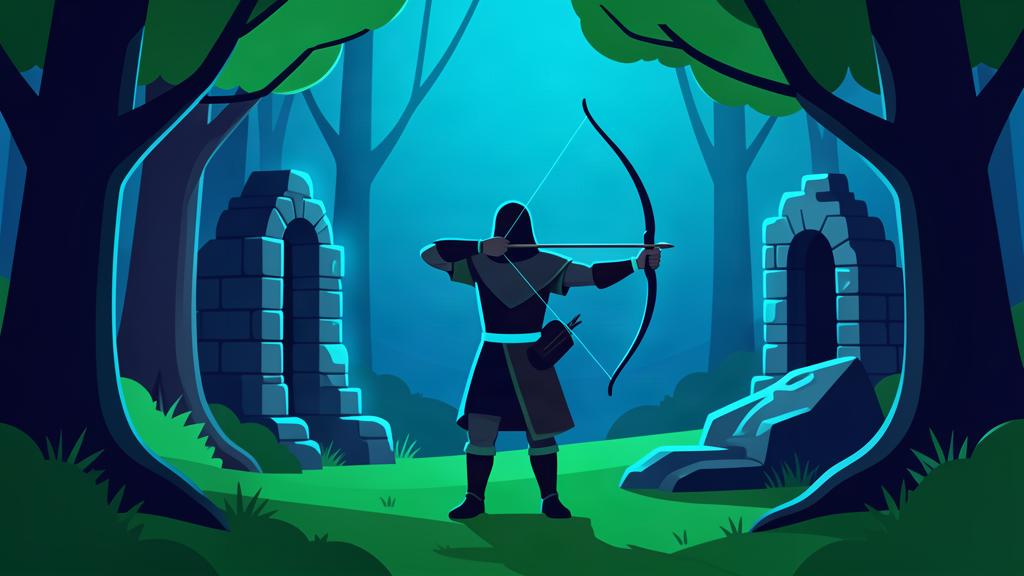
The makers of a new Hollywood film about the final days of Robin Hood have pointed to Northern Ireland as the ideal location for bringing the outlaw’s last stand to the screen — a choice that reflects both the region’s versatility as a filming destination and its deep familiarity with medieval-style landscapes.
The Death of Robin Hood, starring Hugh Jackman and Jodie Comer, was shot entirely in Northern Ireland, a decision that film-makers say was driven by a combination of natural scenery, robust production infrastructure, and a willingness among local crews to take on a large-scale period project. The region’s forests, rocky coastlines, and ancient stone structures have made it a familiar setting for productions that need a place that can stand in for anything from a dense woodland to a far-flung medieval outpost.
A location that does it all
Northern Ireland has steadily built a reputation as one of the UK and Ireland’s most useful film locations. Its landscapes can be surprisingly varied within a short distance — woodland, moorland, dramatic coastal cliffs, and ruined castles all withinreach — which means a production can often move between distinct environments without the logistical headache of relocating to a different country. For a story like Robin Hood’s final confrontation, that variety matters: the film requires places that feel ancient, wild, and slightly untamed, without necessarily belonging to any one specific historical site.
The presence of a skilled local crew base is another major factor. Northern Ireland has spent years building experience through a steady stream of high-profile productions, developing a workforce familiar with period detail, combat choreography, and large-scale logistics. That depth of expertise makes it easier to bring in international stars and still have a production environment that can handle the demands of a feature film with action sequences and period settings.
The appeal of filming outside the capital
A production choosing Northern Ireland over more obvious British locations is often also making a practical calculation about cost and flexibility. London and the south-east of England offer plenty of studio space and historical locations, but they can be expensive and constrained by access, permits, and the sheer density of modern development. Northern Ireland gives productions room to work, often with fewer competing demands on the same locations.
For a film that needs to convince audiences it is transporting them to a different century, that flexibility can be decisive. The forests and rocky terrain of Northern Ireland are not, of course, identical to the England of Robin Hood legends, but they can be shaped, lit, and dressed to suggest a world that feels authentic enough to suspend disbelief. In that sense, the location is not meant to be a literal recreation of a historical place — it is a canvas.

ADVERTISEMENT
Why it matters
The decision to film entirely in Northern Ireland underlines the region’s growing importance as an all-round production hub rather than a niche location for a particular type of scene. It also reflects the confidence of international producers in the local infrastructure: a film with two major stars, period sets, and action demands a location that can handle complexity without constant friction. When Northern Ireland keeps landing those projects, it strengthens the case that the region can support ambitious filmmaking at scale, not just smaller or contained productions.
What happens next
The film is now in post-production, with its Northern Ireland shoot complete. What remains is the editing, scoring, and finishing work that turns raw footage into a finished picture, followed by marketing and release. For the region itself, the lasting effect is the usual one from a major production: jobs for local crew, business for supporting services, and another example that can be used to attract future projects looking for the same blend of scenery and capability.
















We do not allow links of any sort in comments. No SPAM whatsoever. On topic comments only.