

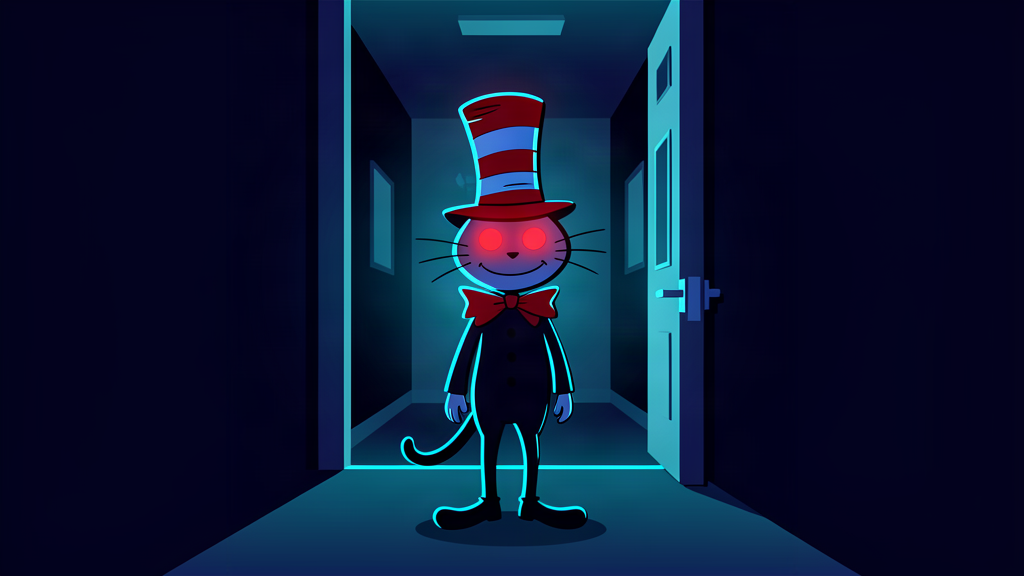
Disturbing video clips appearing to show a sinister version of the Dr. Seuss character Cat in the Hat have sparked police investigations across several countries, after the images began circulating on social media and causing alarm among schoolchildren and parents. The footage, described by authorities as grainy and threatening in tone, appears to have been generated using artificial intelligence, raising fresh questions about how easily AI tools can be used to produce convincing but harmful content aimed at children.
The character at the centre of the scare is instantly recognisable: the tall, whiskered figure in the red-and-white striped hat from Dr. Seuss’s classic children’s books. That familiarity is precisely what makes the altered images so unsettling. For young children, the Cat is a playful figure from bedtime stories and early reading. When that same face appears in a dark, distorted, threatening context, the effect can be deeply distressing.
A familiar character, twisted by AI
The speed with which AI-generated imagery has evolved is at the heart of the problem. Tools that can produce or alter video and images have become far more accessible in recent years, lowering the barrier for anyone with a motive to create content that looks plausible enough to frighten or mislead. In this case, the material appears to have been crafted to exploit that familiarity — taking a beloved children’s character and placing it in a context designed to unsettle.
Police in multiple countries have moved to investigate after reports that the videos were being shared among school-age children, in some cases sparking anxiety and prompting callers to contact emergency services. The international spread of the material has complicated the response, since the same clip can circulate across borders almost instantly, leaving individual forces to assess whether the images originate from a local suspect or are being reposted from elsewhere.
Why children are particularly vulnerable
The distress caused by the videos is not simply a matter of shock. Children at primary school age are still learning to distinguish fictional entertainment from real-world threat, and a menacing version of a character they associate with safety and fun can blur that boundary in ways that are hard to unpick. Schools and parents have found themselves having to explain content that is deliberately designed to be confusing — part cartoon, part threat, all novelty.
The situation has prompted police warnings aimed not only at children but at adults who might share or forward the clips without realising the impact. In an age where a video can be sent in a group chat or posted to a feed with a single tap, the harm can spread faster than the explanation of what the content actually is.

ADVERTISEMENT
The wider AI content problem
This incident sits within a broader pattern that police, educators, and child-safety organisations have been warning about for some time: the use of AI to produce fake, manipulated, or harmful content that targets younger audiences. Deepfake images, fabricated voice recordings, and synthetic video have all been used in scams, harassment, and disinformation campaigns. When the content is aimed at children, the consequences can be both psychological and practical, especially when schools feel forced to divert time and resources to managing the fallout.
The case also highlights a difficult enforcement challenge. Identifying who created the images, where they were first posted, and how widely they have been altered or reuploaded can be extremely difficult once material has circulated across platforms and jurisdictions. That has left police in several countries dealing with a moving target, investigating not just a single video but an ecosystem of copies, remixes, and reposts.
Why it matters
The Cat in the Hat videos matter because they show how quickly AI-generated content can move from novelty to child-safety issue. They also expose how familiar, trusted cultural characters can be weaponised by manipulated media, and how difficult it is for families, schools, and police to keep up when content spreads internationally before a response can be coordinated. For anyone responsible for children’s online safety, the episode is another reminder that the content children encounter is no longer limited to what a human creator decides to publish.
What happens next
Investigations are expected to continue in the countries where reports have been made, with police seeking to identify the source of the original material and trace how it spread. In parallel, schools and child-safety advisers are likely to issue guidance to parents on recognising manipulated media and talking to children about content that is designed to frighten. Longer term, the case is likely to add to pressure on technology platforms to improve detection and take-down processes for AI-generated material that targets or harms children.



















We do not allow links of any sort in comments. No SPAM whatsoever. On topic comments only.