

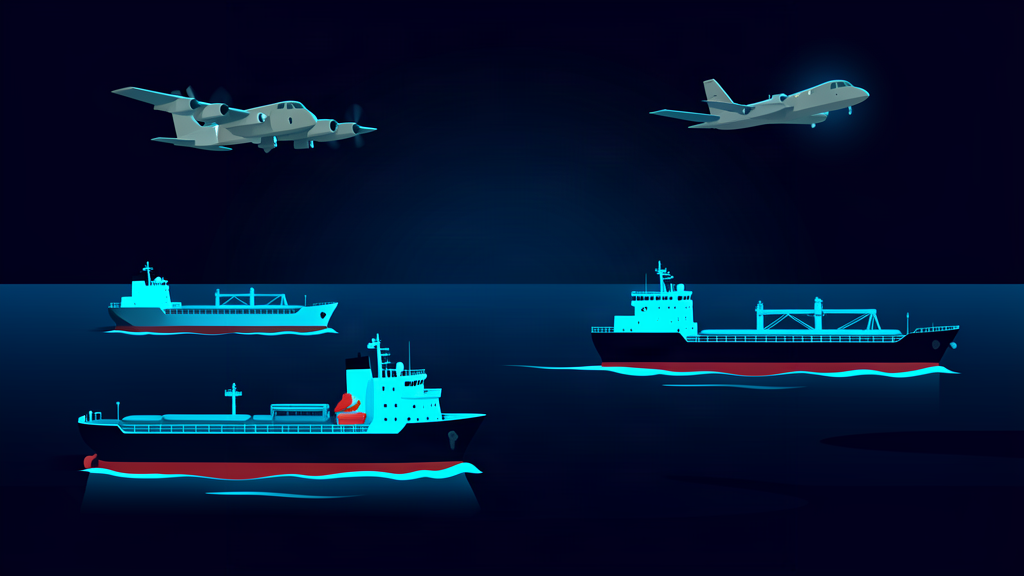
The United States military has carried out a series of strikes against three Iranian-linked oil tankers, claiming the action was a direct retaliation after Iran launched missiles at two American warships in one of the most intense exchanges between the two sides in recent weeks.
The US military said the strikes targeted what it described as a “shadow network” of vessels used to move Iranian oil, striking three tankers in a coordinated operation. The action came days after the two countries exchanged some of their most intense fire in weeks, with Iran firing missiles at two US warships in a move that raised the temperature of tensions that have been simmering across the region for months.
By targeting the tankers, the US has expanded its campaign beyond the purely military domain into the economic infrastructure that underpins Iran’s oil exports, a layer of pressure designed to constrain Tehran’s ability to fund the network of proxies that Washington accuses it of supporting across the Middle East. The “shadow network” designation reflects the murky world of sanctioned oil shipments that operate outside formal channels, often with falsified documentation and ship-to-ship transfers designed to obscure the origin of the cargo.
Iran has not yet publicly responded to the tanker strikes in detail, though the retaliation for the US action is likely built in to the cycle of escalation that has characterised the relationship. The missile attack on the two US warships that preceded the tanker strikes was itself framed by Tehran as a response to earlier American operations, in what has become a tit-for-tat sequence of action and counter-action that has kept regional tensions persistently high.
The US strikes were announced by the military in a statement that emphasised the retaliatory nature of the operation and the direct link to the missile attack on its warships. The timing — coming days after that exchange — suggests a deliberate calculation about the pace of the response, allowing a window for diplomacy and de-escalation to play out before the next deliberate step up the ladder.
Why it matters
This is not a skirmish. The targeting of oil tankers moves the confrontation into the economic bloodstream of the region and into an area where miscalculation carries enormous consequences. A single tanker struck in error could spill oil across an international shipping lane, disrupt global crude flows and send a shock through markets already sensitive to the risk premium imposed by Middle East instability. The involvement of warships and missiles raises the prospect of a spiral in which each side perceives the other’s action as requiring a response of its own, until the cumulative effect produces an outcome neither intended.

ADVERTISEMENT
For Iran, the strike on the tankers is a direct challenge to its ability to generate revenue through oil exports, which remain the backbone of its economy despite years of sanctions. The “shadow network” exists precisely to keep those exports flowing despite the restrictions, and striking at it is a signal that the US is prepared to go beyond the maritime interdictions and sanctions enforcement that have been the more conventional tools of pressure.
For the US, the operation is a demonstration that retaliation for attacks on its warships will not be limited to the naval domain, and that Iran’s economic lifelines are not immune. The question now is whether Tehran chooses to escalate further in kind, or whether the tanker strikes represent a calibrated signal intended to impose costs without triggering a broader conflict.
What happens next
The immediate priority will be whether Iran responds to the tanker strikes in a way that matches or exceeds the previous scale of exchange. A further missile or drone attack on US assets would signal that Tehran has chosen escalation, while a more limited response — or a period of quiet — could indicate an effort to contain the episode. Regional allies will be watching closely, since any widening of the conflict has the potential to draw in partners and proxies on both sides.
The flow of Iranian oil will be a second focus of attention: if the strikes disrupt tanker movements materially, the market will take note and the price of crude could move. Longer term, the episode underscores the fragility of the security architecture in the Gulf and the ease with which a localised exchange can pull the broader region back towards confrontation.
Source: The New York Times — U.S. Strikes Three Iranian ‘Shadow Network’ Oil Tankers, Military Says, 5 September 2026.
















We do not allow links of any sort in comments. No SPAM whatsoever. On topic comments only.