

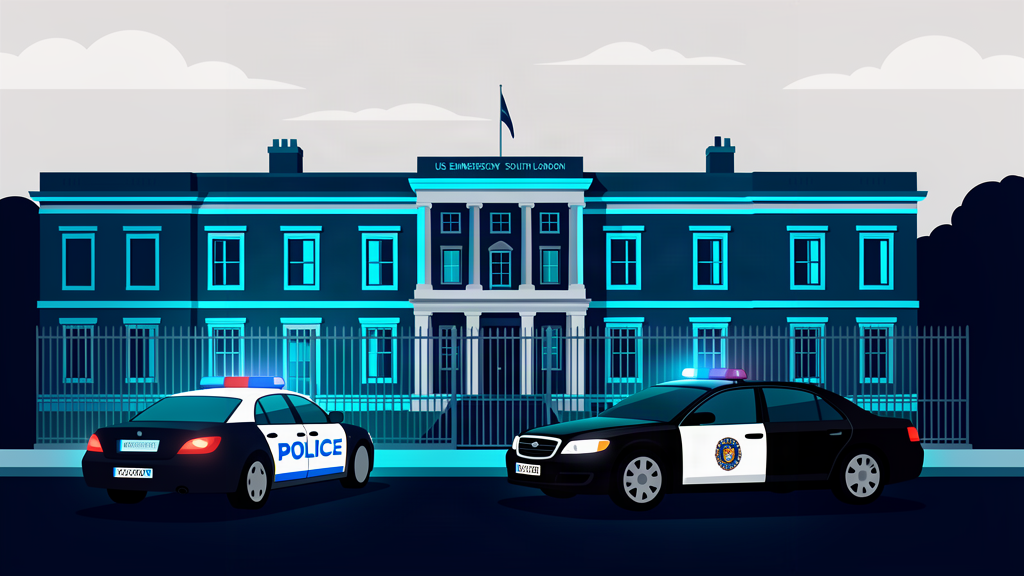
A man who worked at the US embassy in Vauxhall, south London, was flown out of the country before police could interview him over allegations connected to child abuse images, the BBC has learned. The revelation has prompted questions about how diplomatic protection was applied in a case involving serious criminal conduct.
A suspect with diplomatic cover
The individual was employed at the embassy but was not himself a diplomat. Despite that, he held diplomatic protection — a status that allowed him to depart the UK without being questioned by British police who were actively investigating allegations that he had been involved with child abuse imagery. The gap between his formal role and the level of protection he enjoyed is at the heart of what has made the case conspicuous.
UK investigators had been seeking to speak with him in connection with the case before he left. By the time they were in a position to do so, he had already departed, removing the possibility of a straightforward in-country interview and forcing the investigation to adapt.
How diplomatic protection works — and where it can go wrong
Diplomatic protection exists to shield embassy staff from the legal processes of the host country while they are carrying out their official functions. In theory, that means immunity from arrest, prosecution, and in some cases even questioning, so that foreign missions can operate without being subjected to local political pressure or legal harassment. In practice, the boundaries are not always clear, and the system has long been a subject of debate when it appears to be deployed in ways that go beyond its original rationale.
The present case lands in that zone of ambiguity. When the person in question is not a diplomat — when they hold a support or contracted role rather than a diplomatic post — the usual justification for sweeping protection becomes harder to sustain. That does not necessarily mean the protection was unlawful, but it does mean that the decision to extend it is likely to be scrutinised, particularly when it has the effect of preventing a police interview in a live criminal investigation.
Why it matters
The case matters for several reasons. First, it touches on the integrity of the investigation itself. Removing a suspect from the jurisdiction before an interview can make it harder to establish what happened, to assess evidence, and to determine whether a prosecution is viable. Even if the police can pursue lines of inquiry from outside the UK, the absence of a face-to-face interview removes a standard part of the investigative process.

ADVERTISEMENT
Second, it raises broader questions about the application of diplomatic protection in the UK. The public interest in knowing that someone connected to a child abuse image investigation was able to leave the country under protection is obvious. So too is the question of whether the safeguards around that protection are adequate — whether there are sufficient checks to prevent it being used in a way that undermines, rather than supports, the purposes for which it exists.
Third, the case has a diplomatic dimension. The US embassy in Vauxhall is a high-profile mission, and any arrangement that allows someone working there to leave in these circumstances is likely to draw attention from officials on both sides of the Atlantic. The Foreign Office and the embassy itself can be expected to face questions about how the situation was handled.
What happens next
British police are likely to continue the investigation from abroad, working with American authorities and the embassy to establish what they can. Whether the suspect will ever return to the UK for interview or proceedings is unclear, and may depend on diplomacy as much as on law. In the shorter term, the episode is likely to renew scrutiny of how diplomatic protection is assigned, reviewed, and revoked — particularly in cases involving serious allegations. The Foreign Office may face pressure to explain what oversight exists, and whether anything in the current framework would prevent a repeat.




















We do not allow links of any sort in comments. No SPAM whatsoever. On topic comments only.