

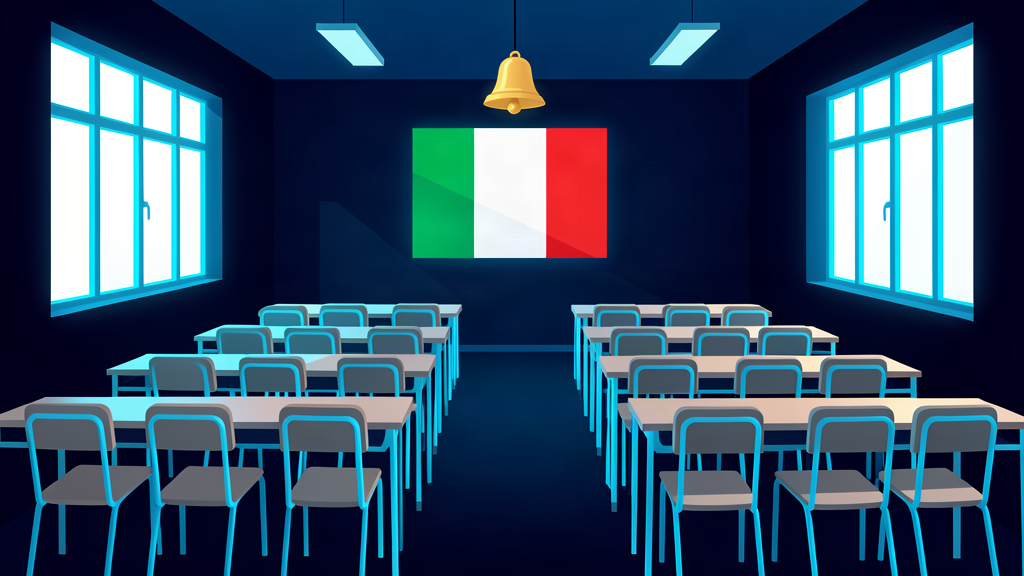
Italy’s Prime Minister Giorgia Meloni has announced plans to ban the wearing of burqas and niqabs — full-face and eye-revealing Islamic veils — in Italian schools, alongside new limits on the number of foreign students in classrooms, as immigration moves to the centre of the political agenda ahead of next year’s general election.
Meloni outlined the proposals on Sunday at a gathering of the youth wing of her nationalist conservative Brothers of Italy (FdI) party in Rome, telling the assembled young supporters that anyone who comes to Italy must “learn our language, understand our culture, and respect our rules.” The measures, she said, were “the only serious way to welcome them.” Her remarks drew a standing ovation.
The veil ban
Under the plan, once approved by the government the changes would need to be passed by parliament within 60 days to become law. Italy does not currently have an explicit ban on full-face veils, though a 1975 law prohibits the use of helmets or garments that make identification difficult without a justified reason. A 2008 court ruling clarified that full-face coverings could be worn for religious or cultural reasons so long as the face is revealed when identity verification is required.
The anti-immigration League party, which sits in Meloni’s ruling coalition, submitted a bill earlier this year that would ban helmets and garments that obscure identification, with exceptions for sporting events and places of worship. Meloni’s announcement appears to build on that legislative effort, bringing the ban specifically into the school setting.
Burqas are full-face veils that conceal the entire face including the eyes, while niqabs are similar but leave the eyes visible. Both are worn by a small minority of Muslim women, and their prevalence in Italy is low — but the symbolic politics of the issue have long been potent on the European right.
Caps on foreign students
Alongside the veil ban, Meloni said she would implement a legal cap on the number of foreign students per class. The detail is less clear: a 30 percent limit on foreign students per class and per school already exists under Italian law, and Meloni did not spell out how her new measure would change the existing framework. Foreign students currently make up approximately 12 percent of enrolment in Italian schools.

ADVERTISEMENT
She also announced that Italian language lessons would be made compulsory for parents of foreign students who are assessed as having “serious difficulties integrating into the school system.”
Why it matters
The announcements come at a politically charged moment. Meloni’s government is Italy’s longest-running administration since the end of the Second World War, but her party is expected to face a serious challenge at the 2027 general election from the National Future (FN) party, which sits further to the right of Brothers of Italy and whose popularity has been climbing in the polls since February.
FN called for a crackdown on the wearing of burqas in schools as early as July, and Meloni’s move can be read as a pre-emptive effort to occupy the ground before her more hardline rivals seize it. Immigration has long been a defining issue for Meloni’s government, and the new measures — language requirements for parents, caps on foreign students, and restrictions on religious dress in schools — fit squarely within the integration-and-identity frame that has shaped her party’s platform.
The religious dress element also intersects with a broader European debate. Several European countries have introduced restrictions on face coverings in public spaces, and the question of how far the state should go in regulating religious expression in public institutions — particularly schools — remains contentious. In Italy, the existing legal framework already touches on identification; what Meloni is proposing is to make that touch explicit and school-specific.
What happens next
The proposals must first be approved by the government, and then — within 60 days — by parliament, where Meloni’s coalition holds a majority but not an unlimited one. The League’s existing bill on face coverings provides a legislative vehicle of sorts, but the details of the school-specific provisions, the student cap, and the language requirements for parents will need to be drafted and scrutinised. Given the 2027 election timetable, the coming months will show whether these measures are intended as practical policy or as campaign positioning — or, more likely, a blend of both.
Source: Al Jazeera (AFP and Reuters)



We do not allow links of any sort in comments. No SPAM whatsoever. On topic comments only.