

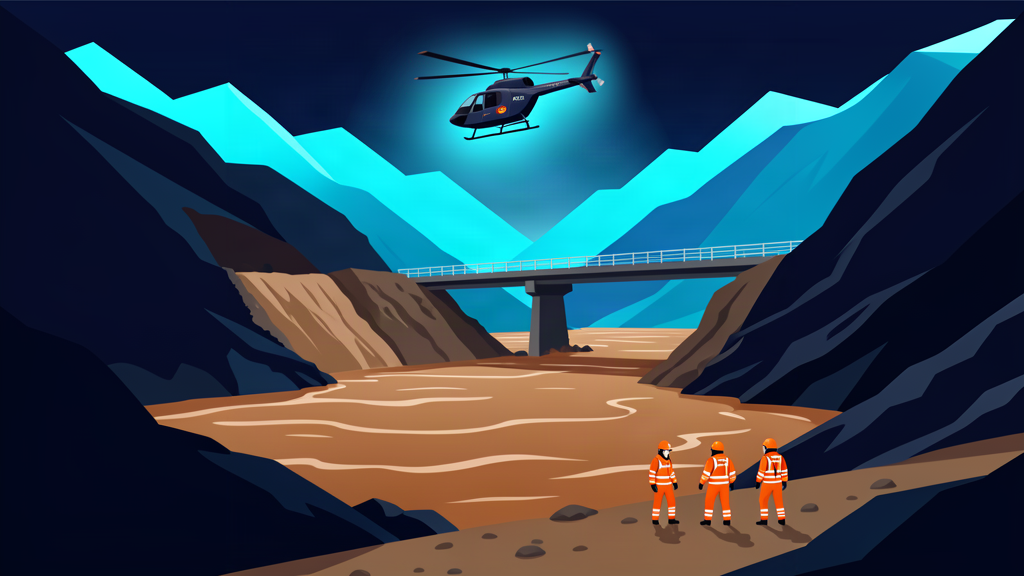
Rescue teams working in the flood-hit border region between Nepal and Tibet are operating under the threat of a second deluge, with Nepali and Chinese authorities warning that a lake created by a deadly landslide could burst open, according to the New York Times. An expert cited in that reporting says another surge of water would pose the greatest danger to the rescuers themselves, who are working in narrow valleys where there is little high ground to retreat to and where road access has already been severed in multiple places.
A hazard created by the disaster itself
When a landslide blocks a mountain river it forms a temporary dam of loose rock and debris. Water builds behind it until the barrier gives way, releasing a fast-moving wall of water and sediment downstream. These outburst floods are among the most feared hazards in the Himalaya precisely because the timing cannot be predicted with confidence, and because the terrain funnels the flow into exactly the places where villages, bridges and rescue staging areas sit. That is the risk authorities are now monitoring while search work continues.
The UK connection
The disaster already has a British dimension, with UK nationals reported missing in the region and the Foreign Office involved in tracing efforts. Nepal is a long-standing destination for British trekkers and mountaineers, and the UK has deep institutional ties to the country through the Gurkha regiments and a substantial Nepali diaspora in Britain, particularly around Aldershot and Farnborough. Families here are following the search closely, and British aid contributions and consular casework are likely to continue for some time after the immediate emergency phase ends.
Why it matters
Beyond the human toll, the episode is a warning about compound risk in high mountain environments. Glacial retreat and heavier, more concentrated rainfall are making landslides and lake-outburst events more likely, and the same conditions make rescue slower and more dangerous. Nepal has invested in early-warning systems on some rivers, but coverage is uneven and the affected zone straddles an international border, which complicates data sharing. The lesson for donor countries, the UK among them, is that resilience funding has to reach the monitoring and evacuation side, not only reconstruction.
What happens next
Authorities will continue to assess the stability of the landslide-dammed lake and may order the withdrawal of rescue teams if the barrier looks close to failing, while search and relief operations resume where conditions allow. Casualty and missing-person figures are expected to be revised as access improves, and the Red Cross and other agencies have already flagged large-scale humanitarian need across the affected districts. Your News will report updated official figures rather than early estimates.
Reported via the New York Times.

ADVERTISEMENT
Source: Original report. Rewrite for Your News Website.





















It’s truly concerning to hear about the risks faced by the rescue teams in Nepal. The threat of a second flood complicates their already challenging work, and I hope they have the support they need to stay safe while helping those affected. My thoughts are with everyone involved in the rescue efforts and the communities impacted by this disaster.
It’s extremely concerning to hear about the potential for a second flood in Nepal. The rescue teams are doing such brave work under terrible conditions, and I hope they have the resources and support they need to stay safe. My thoughts are with everyone affected by this disaster.