

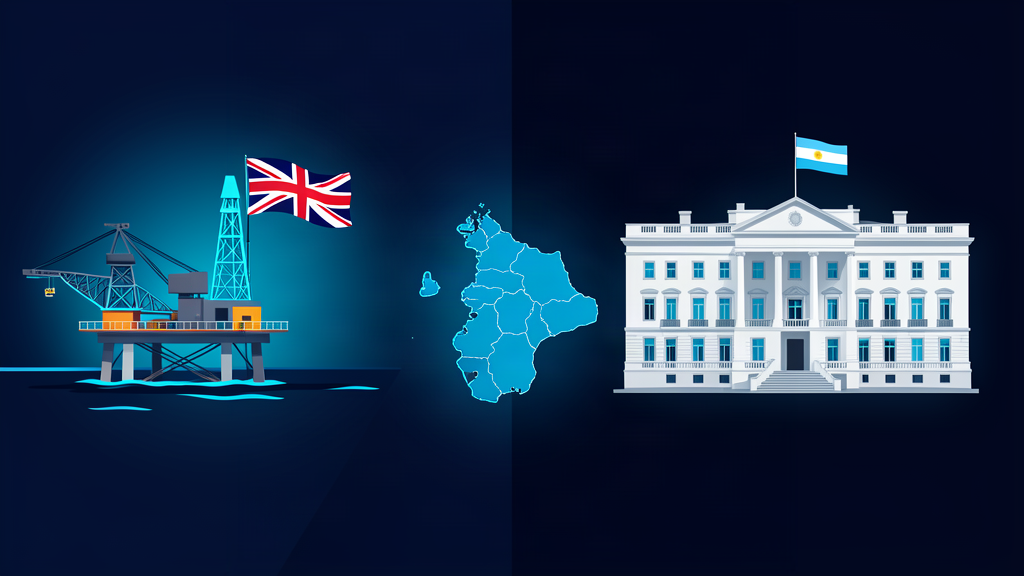
Argentina’s president Javier Milei has escalated the long-running sovereignty dispute over the Falkland Islands by threatening economic sanctions against oil companies planning to explore the Sea Lion field in waters close to the British overseas territory.
Milei’s sanctions threat
In a national address from the presidential palace in Buenos Aires, Milei declared that the Sea Lion oilfield — located roughly 130 miles from the Falklands and estimated to hold 1.7 billion barrels of oil — represented a “clear and present danger” to Argentina’s territorial claim. He said the “winds of change” favoured his country’s position, emboldened by indications that the United States might reconsider its longstanding neutrality on the issue.
The plan outlined by the Argentine leader involves introducing a bill to parliament that would impose sanctions on energy firms participating in what Buenos Aires considers unauthorised hydrocarbon activities around the islands. A current Argentine law already permits restrictions on companies involved in projects the government deems illegal, but the new proposal would tighten that regime significantly.
Two companies are due to begin extracting oil from the Sea Lion field within two years: Rockhopper Exploration, a British firm, and Navitas Petroleum of Israel. Both have been making preparations on the islands, including building a dock, a heliport, and accommodation for oil workers, according to Navitas’s own video materials. Rockhopper has described the field as containing “highly marketable crude”.
Why it matters
This is the most direct challenge to British interests in the South Atlantic in decades. The Falkland Islands are home to around 3,100 people, more than 2,500 of whom live in the capital, Stanley. The overwhelming majority are British citizens, and in a 2013 referendum 99.8% of islanders voted to remain a British overseas territory, with just three votes against.
The Sea Lion field represents potentially significant commercial value, and the prospect of sanctions targeting British and Israeli firms raises questions about how the UK government would respond — whether through diplomatic channels, legal action, or other measures. The British government has reiterated this week that Falkland Islanders “are British with a right to determine their own future”, and BBC News has contacted the government for comment on Milei’s latest statement.

ADVERTISEMENT
The wider geopolitical context is also shifting. Recent reporting has suggested the United States may be reviewing its position on the Falklands, with former President Trump having hinted the US would not necessarily back the UK over the islands. Any change in American neutrality would fundamentally alter the diplomatic landscape.
What happens next
Milei’s government is expected to proceed with its parliamentary bill, though it is not yet clear how or to what extent the sanctions will be imposed. The two oil companies, Rockhopper and Navitas, have been contacted by the BBC for responses to Milei’s comments. The UK government’s formal response will be critical in shaping what follows.
For the islanders of the Falklands, the rhetoric from Buenos Aires will be unwelcome. Teslyn Barkman, a former member of the Falkland Islands Legislative Assembly, told the BBC that Milei’s speech had “probably irked every single Falkland islander” and affirmed that “we have a burgeoning economy for a small place… we will remain forever British”. The coming months will test whether Argentina’s renewed assertiveness translates into concrete action or remains largely symbolic.























We do not allow links of any sort in comments. No SPAM whatsoever. On topic comments only.