

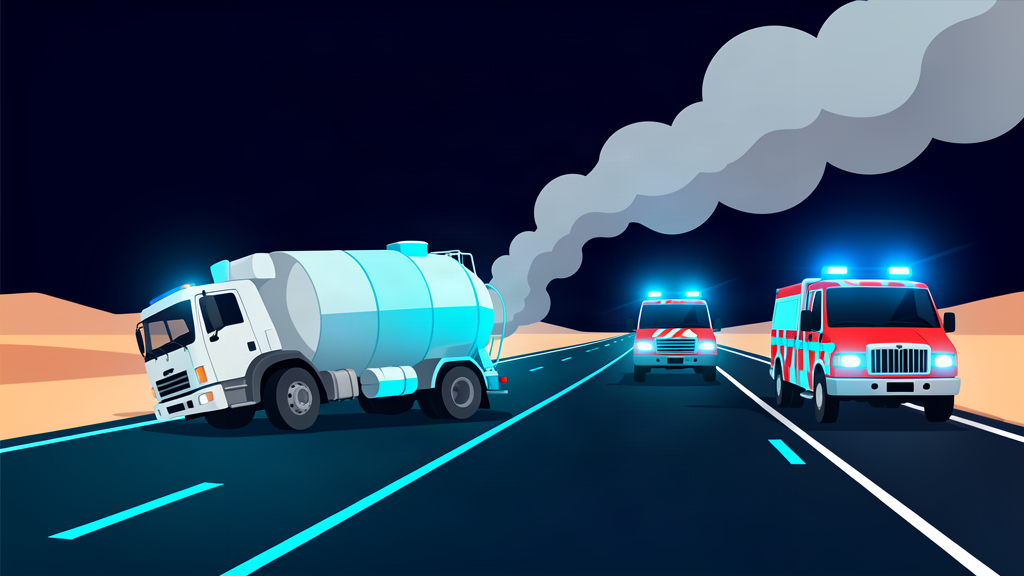
At least 30 people have been killed and 15 others injured after a vehicle carrying petroleum products overturned and caught fire on a major road in Egypt, according to the country’s health ministry. The blaze, reported by Al Jazeera on 25 November, has prompted questions about the safety of transporting hazardous loads on the region’s roads.
What happened
The health ministry says a vehicle carrying petroleum products flipped on a major road before a fire broke out. The cause of the crash has not been established in the reporting available, and Al Jazeera’s account does not say whether other vehicles were involved. What is clear from the ministry’s figures is the scale of the casualties: at least 30 dead and a further 15 injured. Details about those affected, and about how the fire spread, were not immediately available in the feed report.
Road accidents involving fuel tankers and other hazardous cargo are a recurring concern in Egypt and across the region. A crash of this kind combines two dangers: the impact of a heavy vehicle overturning, and the fire risk created by its load. When it happens on a major road, the potential for a large number of casualties is significantly higher.
Egypt’s road network carries heavy freight alongside large volumes of passenger traffic, and accidents involving tankers have drawn repeated calls for tighter checks on loads and routes. The health ministry’s figures put a human cost on those concerns. Al Jazeera’s report does not say what the vehicle was carrying beyond petroleum products, or where exactly on the major road the crash happened, so the precise circumstances remain unclear.
Why it matters
For the UK, the incident matters on two levels. It is a reminder of the risks faced by British travellers on roads overseas, where vehicle safety standards and emergency response can differ sharply from those at home, and a reason to check current foreign travel advice. More broadly, it underlines the fragility of the supply chains that move fuel and other essentials across the region — a route that, when it fails, can cost lives far from any conflict zone.
The tragedy also speaks to a wider regional pattern. Across the Middle East and North Africa, roads that carry fuel and goods between ports and cities pass through areas where emergency services can be some distance away. When a hazardous load catches fire, the speed of the response can determine how many people are hurt. That is a practical concern for residents and visitors alike, not just a headline number.

ADVERTISEMENT
What happens next
Attention will now turn to the cause of the crash and to the emergency response. Egypt’s health ministry has provided the headline casualty figures, but a fuller picture will depend on investigations at the scene and on whether those injured receive the treatment they need. Al Jazeera’s report does not indicate whether an official inquiry has been opened. In the days ahead, the key questions will be why the vehicle overturned, how the fire escalated so quickly, and whether anything can be done to prevent a similar tragedy on the same route.



















We do not allow links of any sort in comments. No SPAM whatsoever. On topic comments only.