

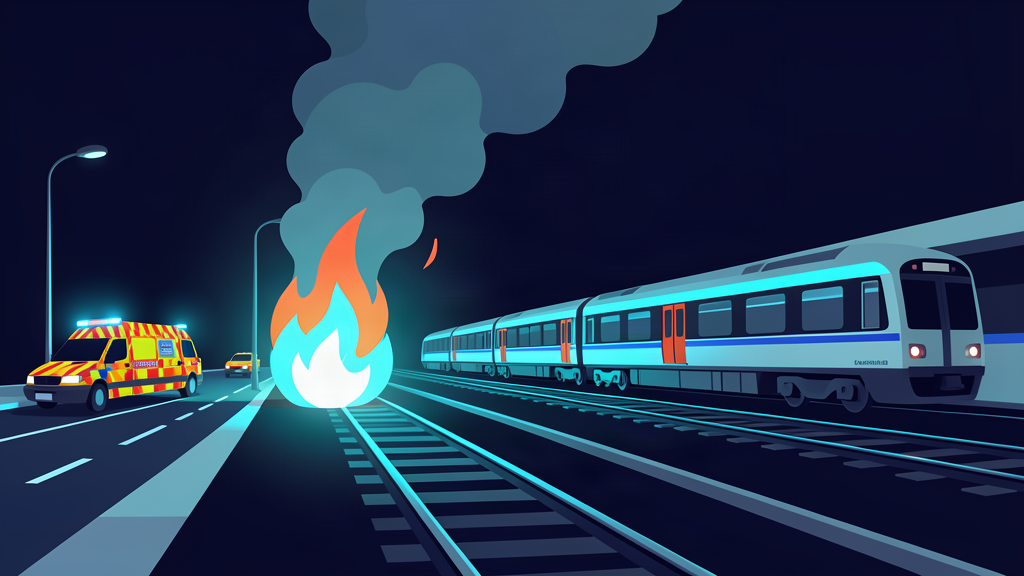
A fire near a railway line in the London Paddington area has caused major disruption to train services, with routes to Heathrow airport cancelled and widespread knock-on effects across the network. The blaze led to an electricity supply failure that blocked all lines between Paddington and the airport, according to National Rail, leaving thousands of passengers facing delays and cancellations during a busy Saturday.
The fire and its immediate impact
The fire broke out close to the railway infrastructure in the Paddington area, triggering an emergency response and cutting power to the overhead lines. That power failure had a rapid effect: services between Paddington and Heathrow were suspended, with all lines in that corridor blocked while the incident was dealt with. National Rail confirmed the scale of the disruption, which extended beyond a single route because of the way the local network is interconnected.
For passengers, the consequences were immediate. Heathrow Express and other services relying on the Paddington to airport corridor were among those affected, and some trains heading further west or into the Thames Valley were also disrupted or cancelled. The impact spread through the timetable, as engineering and operational crews worked to restore the power supply and ensure the route was safe to reopen.
Why Paddington is so important to the network
Paddington is one of London’s principal rail gateways, serving both inner-city passengers and those travelling to and from Heathrow, the UK’s busiest airport. A blockage on the lines out of Paddington does not simply affect one service; it has a cascade effect across the western part of the capital’s rail network and into the surrounding commuter belts. When that blockage is caused by a loss of power rather than a single broken train, the recovery can take longer because the infrastructure itself has to be checked and restored before services can safely resume.
The disruption also affected connections across the wider network. Passengers heading to and from Reading and other destinations in the region found their journeys interrupted, and the effects were felt by travellers using both long-distance and local services. On a busy weekend, with families travelling and airport traffic ongoing, the impact on individual journeys can be significant.
The response on the ground
Emergency services attended the scene, and train operators issued updates as the situation developed. Passengers were advised to check before travelling and to expect delays, cancellations, and crowded conditions on services that were still running. Replacement options were limited by the scale of the disruption, with road transport unable to make up the shortfall on a route designed to handle very high volumes of traffic.

ADVERTISEMENT
The incident also highlighted how dependent rail passengers are on the reliable operation of ageing overhead electric infrastructure. Failures in that system can close large parts of a line at once, and restoration involves not just putting the power back on but making sure the equipment is safe after a fire nearby.
Why it matters
Rail disruption of this kind matters not just to the people directly affected on the day but to the wider economy and to public confidence in the transport network. Paddington is a critical node, and repeated or prolonged problems there ripple across the system. For passengers with appointments, work commitments, or time-sensitive travel — including those flying from Heathrow — a sudden suspension of service can be deeply disruptive.
The incident also serves as a reminder that rail networks are vulnerable to events beyond the control of train operators, from fires and weather to equipment failures and emergency repairs. The response — how quickly information is shared, how well alternatives are offered, and how effectively services are restored — often determines whether the disruption becomes a memorable crisis or a frustrating but contained incident.
What happens next
Engineers will continue working to make the line safe and restore full electrical supply before normal services can resume. Train operators are expected to issue updated timetables as the situation evolves, with some services resuming in stages rather than all at once. Passengers are being urged to check live travel information before setting off, as the full extent of the knock-on disruption may take time to clear.
National Rail and the train companies will also need to assess whether the fire has caused any longer-term damage to the infrastructure, and whether additional inspections or repairs are needed before full capacity can be restored. For those travelling in the affected area, the priority in the short term is to find alternative routes or to defer travel until the line reopens fully.
Source: The Guardian.














We do not allow links of any sort in comments. No SPAM whatsoever. On topic comments only.