

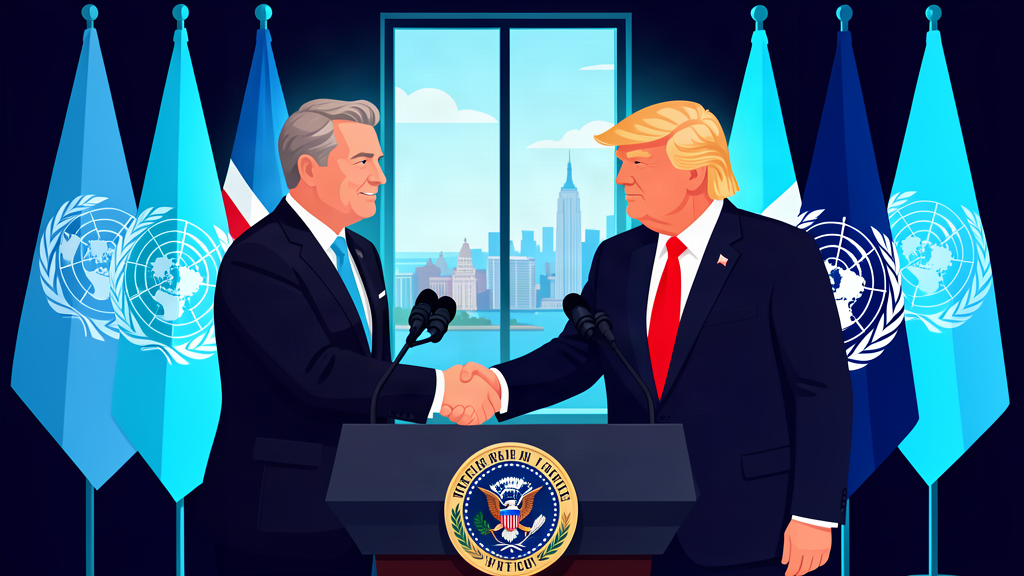
Prime Minister Andy Burnham has arrived in New York for his first face-to-face meeting with US President Donald Trump, telling reporters he expects the two men will find “common ground” despite the substantial policy differences that divide London and Washington.
The Prime Minister is in New York to address the United Nations General Assembly, where his speech is expected to focus heavily on the opportunities and risks posed by artificial intelligence — a technology that both governments have identified as a strategic priority but have approached with markedly different regulatory instincts. The encounter with Mr Trump marks one of the earliest opportunities for the two leaders to meet in person since the current UK government took office.
A first meeting shaped by expectations
Heads of government attending the UN General Assembly regularly stage bilateral meetings on the sidelines of the gathering, and Mr Burnham’s trip has been framed by Downing Street as an opportunity to reset the tone of the relationship and establish how the two administrations intend to work together. The Prime Minister’s remarks ahead of the visit suggested an emphasis on practical cooperation — trade, security, technology — rather than the more combative diplomatic language that has sometimes characterised the UK-US relationship in recent years.
Mr Trump, who returned to office earlier this year, has made clear that he views international alliances through a transactional lens, and the British government is understood to be preparing for a conversation in which ambitions for closer economic ties sit alongside unresolved disagreements over trade terms, defence spending commitments, and the regulatory treatment of big technology firms.
The AI speech: what the Prime Minister is expected to say
The UN podium gives Mr Burnham a high-profile platform to set out his government’s thinking on artificial intelligence, an area where the UK has been keen to position itself as a convenor between the United States, European partners, and the faster-moving governments of the global south. British officials have previously argued that AI governance cannot succeed unless it reflects the concerns of countries that are building the chips, training the models, deploying the systems, and regulating the outputs — and the Prime Minister’s speech is expected to strike that balance.
The focus on AI also reflects domestic pressures. The UK public sector has been making steady, if uneven, progress in adopting digital tools, and the Prime Minister has previously linked the effective use of technology to the performance of the NHS, schools, and local government. A speech at the General Assembly gives him the chance to frame those domestic aims inside a broader argument about international coordination, safety standards, and the economic opportunities tied to the technology’s spread.

ADVERTISEMENT
The speech is also being watched for any signal about how the UK intends to handle the more contentious questions around AI governance — including the extent to which the government is prepared to push for binding international commitments, how it will respond to industry arguments about over-regulation, and whether it will seek to differentiate its approach from the European Union’s more prescriptive framework.
Why it matters
The meeting matters because it is the first real test of how the Burnham government intends to handle the world’s most powerful bilateral relationship at a time when American foreign policy is being rewritten in ways that are still settling out. A smooth, productive encounter would reinforce the Prime Minister’s argument that the UK can remain a useful partner to Washington even as other relationships shift. A difficult one would sharpen questions about the government’s broader diplomatic strategy at a moment when the UK is trying to define its place after significant recent changes at home and abroad.
The AI speech matters for a separate reason: it will be read as the clearest available signal of how the Prime Minister plans to position the UK inside the global debate over a technology that is reshaping economies, public services, and the workforce in ways that are still unfolding. Governments are under pressure to act, but the right balance between innovation and control remains contested, and the Prime Minister’s remarks will be scrutinised for hints of where his administration intends to draw the line.
What happens next
If the meeting goes ahead as planned, the two leaders’ teams will be looking for a joint read-out that can be presented as a concrete step forward, even if the real work of negotiation continues behind the scenes. Watch for references to follow-up conversations, working groups, or a future visit — the familiar furniture of a diplomatic relationship being nudged in a more constructive direction.
After New York, attention will turn to how the Prime Minister’s UN remarks are received by the UK public, the opposition, the technology industry, and international partners. If the speech is well received, it could ease some of the political pressure around the government’s AI policy and give ministers more room to develop their approach. If it lands less well, expect a sharper domestic debate about whether the government is being ambitious enough, or whether its international posture is drifting away from the priorities of voters and businesses at home.
















We do not allow links of any sort in comments. No SPAM whatsoever. On topic comments only.