

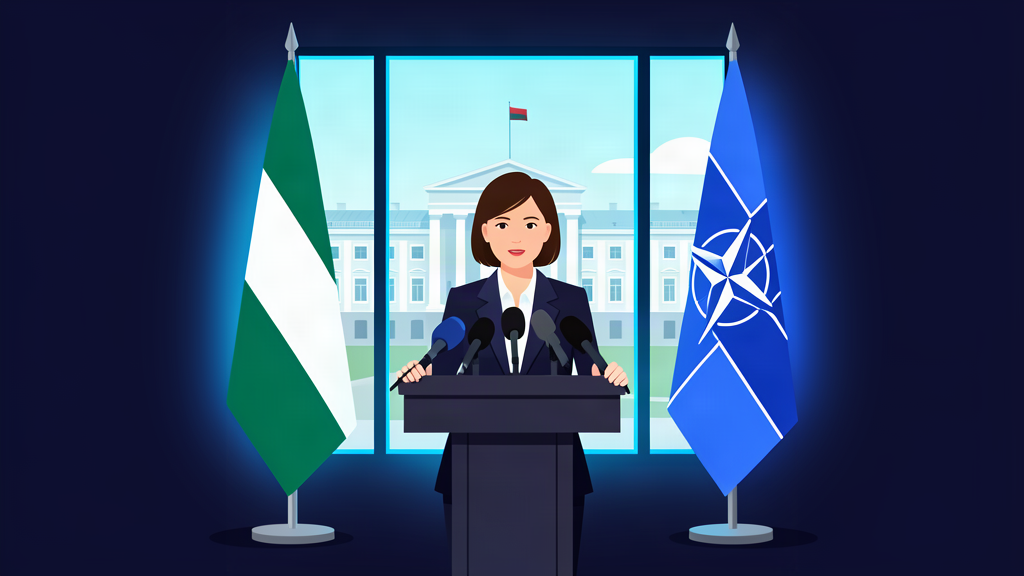
The Prime Minister of Lithuania has told the BBC that her country is ready to “fight back” against Russia if it is attacked, while insisting that the nation also maintains evacuation plans because ordinary Lithuanians feel “constantly threatened” by Moscow. The remarks were made in an interview with BBC Newsnight ahead of the UN General Assembly, where European security on NATO’s eastern flank has become one of the most immediate topics on the diplomatic agenda.
Gintarė Skaistė’s comments reflect a mood that has become familiar across the Baltic states and much of eastern Europe: a conviction that the security environment has changed for good, that the threat from Russia is not a temporary posturing but a standing condition, and that deterrence depends on both the willingness to resist and the practical preparation to manage the consequences if deterrence fails. The combination is important. It is one thing to say a country will fight; it is another to plan for what happens to its citizens if the worst comes to pass.
A country that feels under continuous pressure
Lithuania’s sense of exposure is not abstract. Its border with Russia’s Kaliningrad exclave and its proximity to Belarus place it squarely in one of the most heavily militarised parts of Europe. For a country of its size, that geography carries an outsized weight. The Prime Minister’s language — “constantly threatened” — captures the way in which Russian behaviour over the past decade, from the annexation of Crimea to the full-scale invasion of Ukraine, has reshaped how smaller NATO members assess their risk.
That feeling has practical consequences. It shapes defence spending, force posture, civil defence planning, and the political conversation at home. In a country where security is not a theoretical issue but a daily domestic subject, leaders cannot afford to sound ambiguous about either resolve or readiness. Skaistė’s remarks were calibrated to do both: to tell Moscow that Lithuania is serious about resisting attack, and to tell Lithuanians and their allies that the government has faced up to the harder question of what happens if the country is drawn into a wider conflict.
“Fight back” and the question of evacuation
The Prime Minister’s willingness to say that Lithuanians are prepared to “fight back” is the easier part of the message to broadcast politically. The more delicate part is the evacuation planning. Mentioning evacuation plans can be read two ways at once. It can look like prudence and responsible governance — the kind of preparation any government should make for a reasonable worst case. It can also look like an implicit concession that the country’s leaders do not believe they can fully protect their population in the event of invasion. In practice, both readings can be true at the same time, and the Prime Minister’s interview seems designed to hold that tension without resolving it.
That balance matters for NATO, too. The alliance depends on the credibility of its eastern members as much as on the collective response of the larger powers. If a government like Lithuania’s is seen as both determined and realistic — willing to fight, but also planning for civilian protection — it reinforces the broader deterrence message. If it sounds like panic, it weakens that message. Skaistė’s choice of words suggests she is aware of that line and is trying to stay on the right side of it.

ADVERTISEMENT
Why it matters
The interview matters because it gives a concrete, spoken version of the security dilemma that now defines much of northern and eastern Europe. Lithuania is not the largest or most powerful member of the alliance, but it sits on one of the most sensitive borders in the continent, and what its leaders say about threat, resistance, and preparation has a direct bearing on how the crisis in Ukraine is understood by neighbouring states.
It also matters because evacuation planning has moved from a technical detail to a political subject. In many countries, civil protection planning is handled quietly, in ministries and emergency services, with little public attention. In Lithuania, by contrast, it has become part of the public conversation about national survival. That reflects how far the baseline assumptions of European security have shifted, and how much is being asked of governments that are small relative to the scale of the danger they face.
What happens next
The next test is whether the Prime Minister’s words are matched by visible follow-through. Lithuania’s allies will be looking for evidence that deterrence is being strengthened on the ground: troop deployments, ammunition stocks, air defence, infrastructure hardening, and the resilience measures that make a country harder to coerce. Domestically, the government will be judged on whether its evacuation planning is seen as reassuring preparation or as an unwelcome reminder of how exposed the country is.
For the rest of Europe and for NATO, the broader question is whether countries on the eastern flank can convert anxiety into sustained capability and whether the political will to spend, plan, and prepare holds once the immediate news cycle moves on. Skaistė’s interview lands in that wider context: it is both a local warning and a reminder that the eastern edge of the alliance remains one of the most volatile places in European security.











We do not allow links of any sort in comments. No SPAM whatsoever. On topic comments only.