

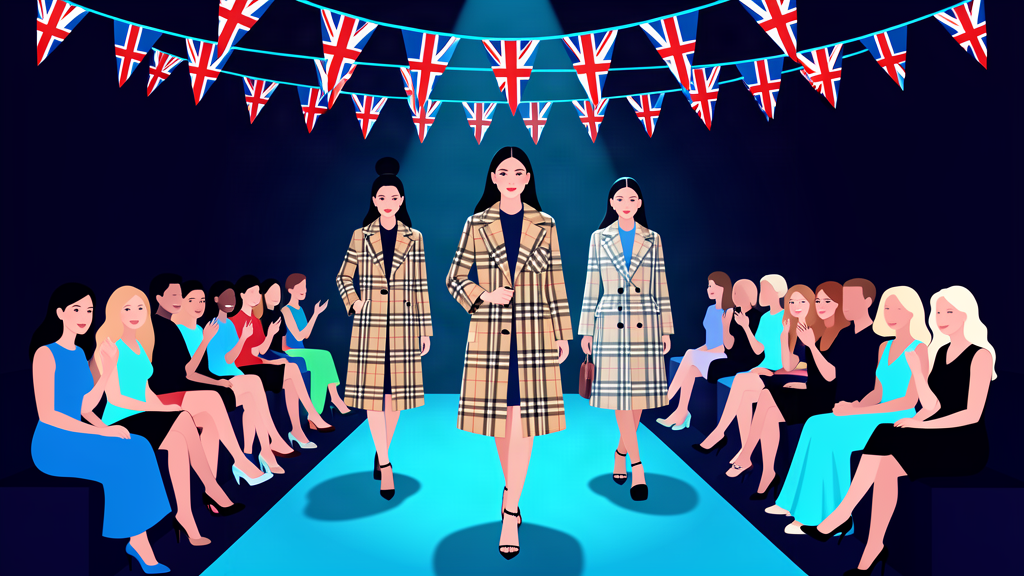
Burberry brought London Fashion Week 2026 to a close with a show that doubled as a statement of intent: the house’s signature check pattern was everywhere, and the front row read like a roll call of the British fashion world’s heaviest hitters. The collection was less a nostalgic exercise in heritage printing than an argument that Burberry’s most recognisable visual asset still has something new to say.
The check, reclaimed
For a brand whose name is so tightly bound to a pattern that it has become shorthand for a whole era of British fashion, Burberry’s challenge has always been how to keep the check from becoming a costume. This show addressed that problem by treating the check not as a single hero motif but as a family of textures that could be deployed in different registers across the collection. Some pieces put it front and centre; others used it as a subtle woven detail or a printed lining, letting the pattern earn its place rather than shouting it.
That approach matters for a house operating at the intersection of heritage and contemporary fashion. The check is both a commercial asset and a cultural reference, and the way a brand deploys it signals how seriously it takes its own history. Showing it in a range of applications suggested a team confident enough in the pattern’s staying power to let it work at different volumes rather than relying on a single showstopping gesture.
The colour palette stayed close to Burberry’s established vocabulary, which helps the collection feel continuous with what came before while leaving room for the cut and fabric to carry the weight of the argument. When a brand is as closely identified with a pattern as Burberry is, every collection has to pull double duty: it has to be clothes first and a statement about identity second, and this show struck that balance with a reasonable degree of conviction.
A front row that tells its own story
The celebrity and industry presence in the front row was as much a part of the message as the clothes. London Fashion Week has become an increasingly crowded platform for British talent, and a front row stacked with familiar names is a signal that a house is in active conversation with the cultural moment rather than operating in a heritage bubble.
That kind of presence also matters commercially. Fashion weeks are as much about visibility and relationships as they are about the garments on the runway, and a strong front row helps a brand project a sense that it is connected to the broader ecosystem of fashion, music, and culture that surrounds it. For a British house showing in London, that connection is particularly important because the home advantage is one of the assets that separates a global luxury brand from a heritage brand doing a nostalgia set.

ADVERTISEMENT
London’s wider fashion week context
Burberry’s closing show landed in a London Fashion Week that has spent the past several seasons building a case for itself as a hub for both established luxury and emerging talent. The city’s fashion week has been working to punch above its weight in a global landscape where Paris and Milan still set much of the agenda, and a strong closing show from one of Britain’s most internationally recognised houses is a useful counterweight to any suggestion that London is merely a waiting room for the bigger European capitals.
The trends on display across the week, as reported from the shows, pointed toward a mix of practicality and statement dressing, with particular emphasis on fabrics and cuts that translate to real wardrobes. Burberry’s collection sat in that same territory, which is perhaps the most useful thing a heritage luxury brand can do: present itself as relevant to the way people actually dress rather than as a museum piece.
Why it matters
Burberry’s performance at London Fashion Week is a barometer for the health of British luxury fashion more broadly. A house that can draw a strong front row and make its most famous pattern feel current is a house that has not lost its grip on its own identity, and that matters for a UK fashion sector that is always trying to prove it can compete on the global stage without simply repurposing its history.
The broader significance is commercial as much as cultural. Fashion weeks are marketing events, and the visibility a strong show generates feeds into everything from retail interest to press coverage to the brand’s own sense of momentum. For Burberry, which operates in a crowded luxury market, a confident fashion week is a reminder that heritage and relevance are not mutually exclusive.
What happens next
The immediate task is to see how the collection translates from runway to retail, and whether the pieces that drew the most attention on the catwalk find an audience when they land in stores and on the brand’s own channels. Fashion weeks are only one moment in a long cycle, and the real test of a collection is whether it sustains interest beyond the opening night.
Longer term, the question hanging over any heritage brand showing its signature pattern is whether it can keep finding new ways to make it mean something. Burberry’s closing show suggested the answer is still unfolding, and the next few collections will tell us whether this was a confident restatement or a one-off flourish.
















We do not allow links of any sort in comments. No SPAM whatsoever. On topic comments only.