

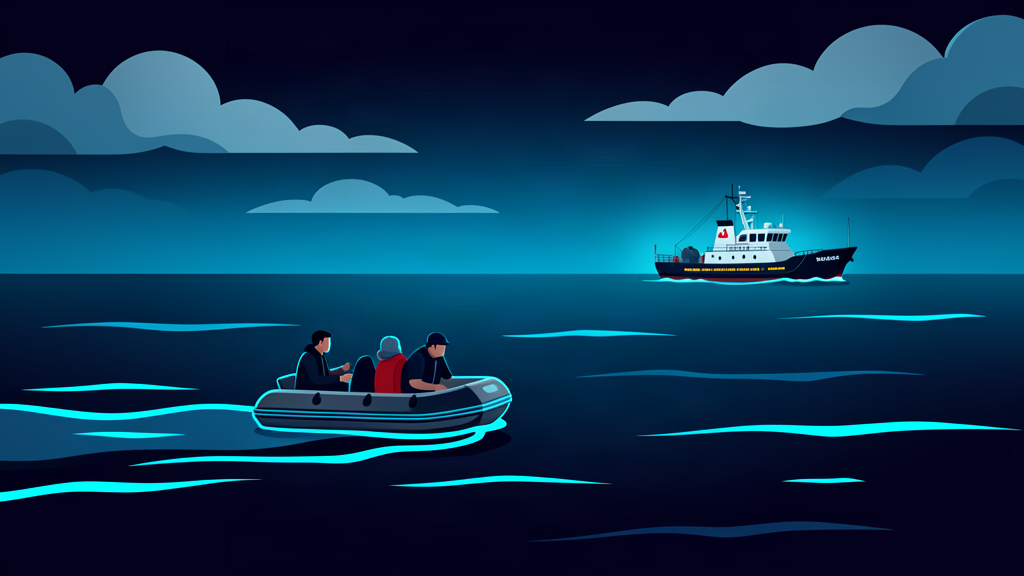
A small inflatable dinghy carrying migrants was at sea for more than 33 hours before it was intercepted on its way towards the UK, French officials have said. The unusually long exposure time has drawn attention to the conditions people are enduring on the crossing and to the wider dynamics of the Channel migrant route.
A crossing that tests the limits
Crossings of the English Channel on small boats are typically measured in hours rather than a day and a half. A journey of more than 33 hours is well outside the usual range, and the length of this one has raised questions about what went wrong along the way. French officials have pointed to the duration as a sign of how exposed passengers can be when a crossing goes on longer than planned, with little shelter, limited supplies and no guarantee of swift assistance.
The Channel crossing remains one of the most heavily monitored maritime migration routes in Europe. Both the UK and France have invested heavily in surveillance, patrol, and intelligence-sharing intended to catch boats before they reach British waters. A vessel that stays at sea for more than a day and a half suggests either a navigational problem, a weather delay, a breakdown, or an attempt to evade detection that went on longer than the people on board anticipated.
The conditions on a small inflatable boat over such a period are punishing even in calm weather. Space is limited, supplies are minimal, and there is little protection from sun, wind, or sea spray. When a crossing stretches to this length, the risk to people on board rises with every hour, particularly for children, the elderly, and anyone with existing health problems. French officials have been careful to stress the human cost alongside the operational facts.
What French officials said
French authorities have described the boat as having been at sea for more than 33 hours before it was intercepted while heading towards the UK. Their account puts the focus on the length of the journey and the conditions aboard, and it serves as a reminder that the Channel route is not a single, uniform experience of a short, dangerous dash across the water.
The detail that the vessel was heading towards the UK matters because it places the incident squarely within the ongoing bilateral dynamic between London and Paris over Channel crossings. The two governments have spent years negotiating how to share responsibility for preventing departures from French beaches and for dealing with boats once they are at sea. Every significant incident feeds back into that relationship, and the length of this crossing is likely to be cited in arguments about the adequacy of current enforcement and rescue arrangements.

ADVERTISEMENT
The wider context of Channel crossings
The Channel migrant route has been one of the most politically charged issues in UK politics for several years. Crossings peaked in 2022 and have since been the subject of repeated policy announcements, bilateral agreements, and sustained public debate about border security, asylum policy, and the safety of the route itself. Each new incident is measured against that backdrop, and the duration of this particular crossing gives it an unusual hook for public attention.
The broader pattern is one of fluctuating numbers, seasonal variation, and periodic spikes that reshape the political conversation. A long-duration crossing tends to generate coverage beyond the usual framing because it raises questions that are harder to dismiss as routine: about how people are getting to the water, about what they are carrying, about whether existing patrol and rescue capacity is matched to the reality on the ground.
Why it matters
A crossing that lasts more than 33 hours is not just a statistic. It is a reminder that the Channel route remains dangerous and unpredictable, and that the people attempting it are exposed to serious risk for prolonged periods when things go wrong. For the UK and France, incidents like this keep pressure on both governments to show that their enforcement and cooperation arrangements are actually reducing the number of dangerous departures, not just intercepting them after the fact.
There is also a humanitarian dimension that does not disappear just because the politics are polarised. Whatever people’s views on migration policy, a small boat at sea for a day and a half with people on board without proper shelter or supplies represents a genuine safety emergency, and the response to it matters for the people involved and for the credibility of the systems meant to protect them.
What happens next
The immediate next step is the standard processing that follows a Channel interception: checking on the welfare of those rescued, establishing their identities, and moving them into whatever legal and administrative process applies. The facts of the crossing itself, including how it managed to stay at sea so long, may emerge more fully once investigations are complete.
In the wider political sense, the incident will likely be woven into the continuing debate over Channel crossings. That debate is unlikely to be settled by any single episode, but each one gives both advocates and critics of current policy a new piece of evidence to point to. The question that will persist is whether the practical situation on the Channel is improving in ways that reduce both the volume of crossings and the frequency of incidents like this one.










We do not allow links of any sort in comments. No SPAM whatsoever. On topic comments only.