

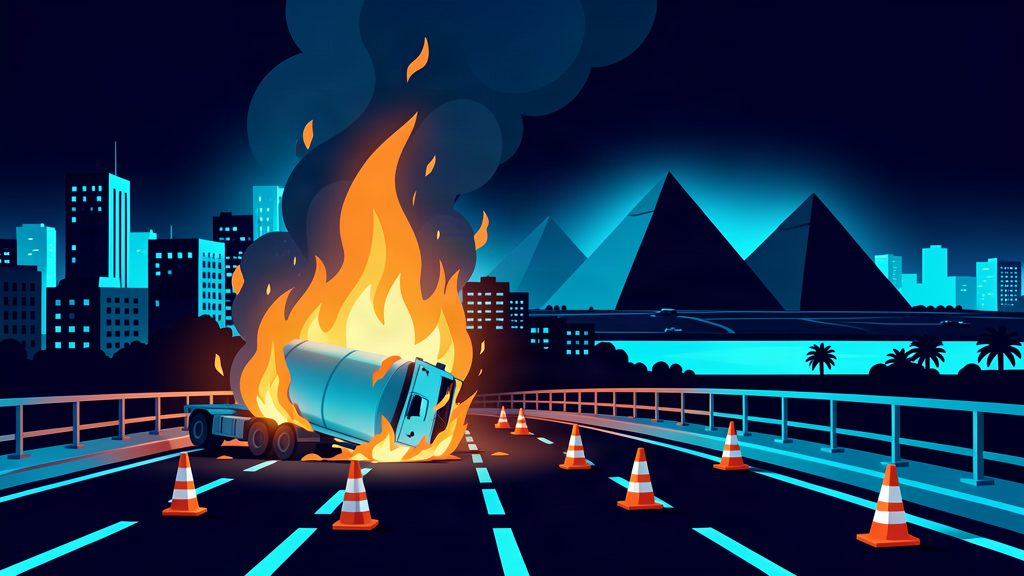
Egypt remains one of the most popular holiday destinations for British travellers, and the scenes emerging from Cairo today will strike a familiar chord with anyone who has used the capital’s roads. A fuel tanker has overturned and caught fire on a busy ring road, killing at least 31 people and injuring 21 more, according to reports from BBC News and the New York Times. The inferno, described as massive, broke out after the tanker crashed near Giza beside the Nile, raising immediate questions about the movement of hazardous loads through crowded urban areas and the safety of a transport network used by residents and visitors every day.
What happened on the ring road
Details in the early reports are limited, but the accounts carried by both organisations agree on the broad outline. The tanker is reported to have overturned on a busy ring road in the Egyptian capital before erupting into flames. BBC News reported that 31 people were killed and a further 21 injured, while the New York Times, citing officials, put the toll at at least 31 dead and at least 21 hurt near Giza, beside the Nile River. That stretch of road runs close to one of Egypt’s most recognisable landmarks and carries heavy traffic, so the risk to other motorists and nearby buildings would have been acute. Neither report gave the tanker’s destination or its cargo beyond the description of it as fuel-laden, and both stressed that the figures were based on information available at the time.
Why it matters for British travellers
For Britain, the tragedy is a sharp reminder of the risks that can accompany travel in a country millions of UK visitors know well. Egypt’s resorts and historic sites draw large numbers of British holidaymakers each year, and many will travel by road between airports, cities and the Nile Valley. Incidents involving large vehicles carrying fuel are a particular concern because of the fire risk and the difficulty of evacuating people quickly on a crowded carriageway. The crash also renews attention on the standards applied to the transport of dangerous goods and on the quality of the roads that link Egypt’s main population centres. UK travellers are advised to keep up to date with Foreign, Commonwealth and Development Office guidance and to consider the safety record of local transport operators when making arrangements.
The wider context is a corridor that serves both local commuters and tourist traffic heading towards the pyramids and the Nile. Accidents involving heavy goods vehicles tend to draw scrutiny because they combine speed, congestion and volatile cargo in a single location. For British visitors the practical lesson is unglamorous but important: allow time for journeys, use reputable transport providers and follow local advice about road conditions. That is especially true around major urban centres, where the margin for error is small and the consequences of a collision can spread quickly.
What happens next
Attention now turns to establishing exactly why the tanker left the road and whether any safety failings contributed to the scale of the disaster. In the immediate term, the priority for the Egyptian authorities will be treating the injured, supporting the families of those killed and clearing the scene so traffic can resume. Investigators will be expected to examine the vehicle, the road conditions and the circumstances of the crash, and any findings may prompt a review of how fuel shipments are routed through urban areas. For the UK Foreign Office, the question is whether the incident changes the practical advice offered to British visitors, particularly those planning road journeys. The reports carried by BBC News and the New York Times did not indicate a change to travel guidance, and nothing in the available information suggests British nationals were among the casualties. Further details are expected to emerge as the investigation develops.
There will also be questions about accountability. When a hazardous-load crash causes mass casualties, attention usually falls on the operator, the licensing regime and the emergency response. None of those questions can be answered from the early reports, and it would be premature to assign responsibility. What is clear is that a single vehicle failure on a busy road has produced a toll that will reverberate well beyond Cairo. For the families of the dead and injured, the coming days will be about confirmation and care rather than explanation.






















We do not allow links of any sort in comments. No SPAM whatsoever. On topic comments only.