

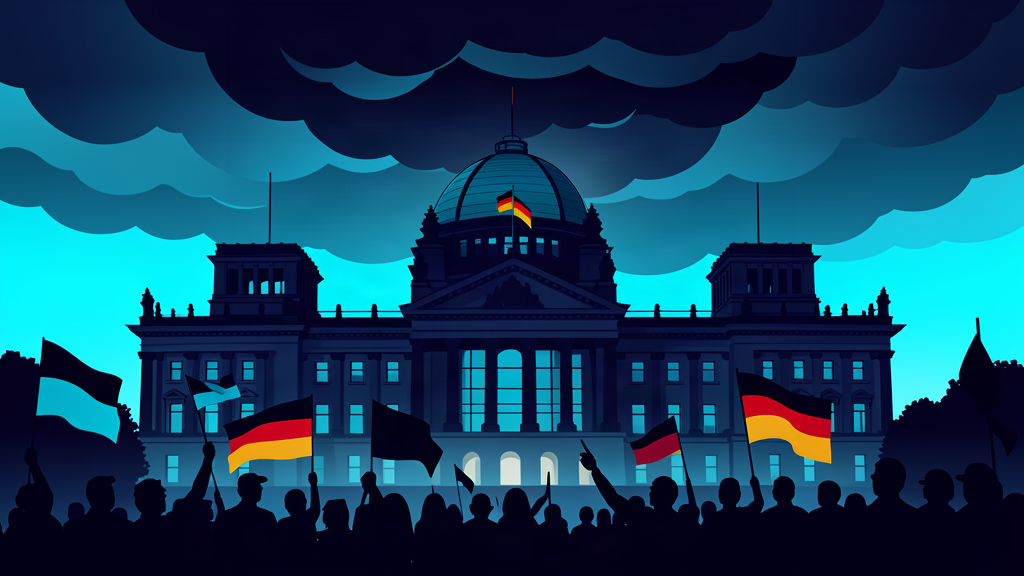
Germany’s long-standing policy of keeping the far right out of government is facing its most serious test in years after a decisive election result in one of the country’s eastern states handed a landslide victory to the Alternative for Germany (AfD).
A blowout win that shakes the political order
A state election in eastern Germany has delivered a decisive victory to the far-right Alternative for Germany party, in what political analysts are describing as a seismic shift in the country’s political landscape. The result has exposed deep divisions among voters over whether the country should continue its decades-old strategy of refusing to work with extremist parties.
The so-called “firewall” — a term used in German politics to describe the mainstream parties’ refusal to form coalitions with the far right — has for decades been a cornerstone of post-war German political norms. It was built in response to the country’s history, with mainstream parties determined to keep extremists out of positions of governmental power.
The result in this eastern state, however, suggests that the firewall is fraying. Voters in parts of the former East Germany have shown increasing willingness to back the AfD, and this election result represents a significant escalation of that trend.
The firewall under pressure
The firewall has historically held firm because Germany’s mainstream parties — across the political spectrum — have consistently ruled out sitting with the AfD. Even when the far right has gained ground in opinion polls or won seats in regional parliaments, established parties have declined to enter formal coalitions with them.
This election, however, raises uncomfortable questions. When a far-right party wins a substantial share of the vote in a state election, the arithmetic of government formation can become extremely difficult. A party that wins enough seats to be a necessary coalition partner puts mainstream parties in an awkward position: exclude them and struggle to form a government, or break the firewall and risk the political and moral implications of sharing power with a party many voters and politicians regard as beyond the pale.

ADVERTISEMENT
The AfD has increasingly positioned itself as a protest vehicle for voters who feel ignored by the mainstream. Immigration, economic anxiety, and discontent with established political institutions have all fed into its rise. In eastern Germany in particular, the party has capitalised on dissatisfaction that predates its formation, rooted in the experiences of the post-reunification years.
Why it matters
The outcome matters far beyond the borders of a single German state. Germany is the largest economy in Europe and a central player in the European Union. Its domestic political stability has implications for the continent as a whole. A weakening of the firewall — or even the perception that it is weakening — sends a signal to other far-right parties across Europe and to political opponents domestically.
It also matters for the millions of Germans who voted for mainstream parties and who regard the firewall as a guardrail against extremism. The question of whether that guardrail can survive repeated electoral setbacks for the established parties is now squarely on the political agenda.
For the rest of Europe, the result is being watched closely. Far-right parties have made gains in several European countries in recent years, and the German example carries particular weight given the country’s history and its central role in the EU. Whether Berlin’s political establishment can hold the line has implications for the broader trajectory of European politics.
What happens next
The immediate question is how the state’s political parties respond to the election result. Government formation in Germany’s system of proportional representation often involves protracted negotiations. The mainstream parties will have to decide whether they can form a working majority without the AfD, and whether they are willing to do so in the face of a strong far-right showing.
At the national level, the result is likely to intensify debate about the future of German politics. Political leaders will be under pressure to address the grievances that have fuelled support for the AfD, while also defending the firewall as a principle. The coming weeks and months will show whether the mainstream can absorb the shock of the result or whether the political landscape has shifted in a more lasting way.
For now, the firewall holds — but this election has shown that it is under more pressure than it has been in years. How that pressure plays out will shape not only German politics but the wider European political climate.
Source: The New York Times. Read the original report at the NYT →














We do not allow links of any sort in comments. No SPAM whatsoever. On topic comments only.