

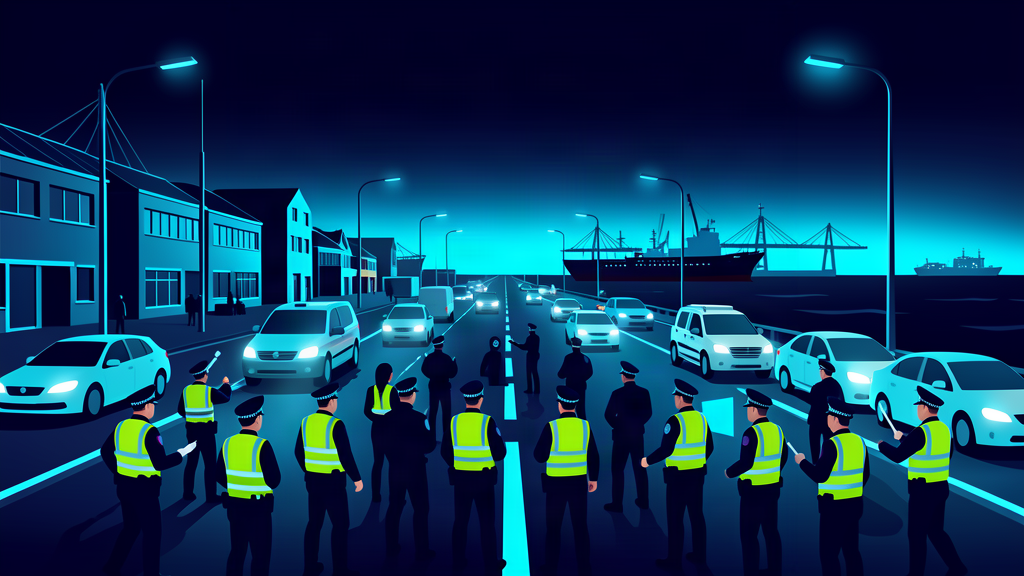
Police officers were injured and a government minister has condemned the violence after anti-migrant protesters blocked roads in Portsmouth following the rescue of 120 people from a single dinghy in the English Channel. Home Office minister Sarah Jones told MPs the disorder was “intimidating and thuggish”, as emergency services struggled to keep the port city moving while officers faced a hostile crowd.
A rescue that sparked confrontation
The sequence of events began when a single inflatable dinghy carrying 120 people was intercepted in the Channel, one of the busiest migrant crossing routes in Western Europe. The scale of the arrival — more than twice the typical number for a single vessel — immediately drew a crowd to the area where the migrants were being processed. What began as a gathering quickly turned confrontational, with protesters blocking roads and directing hostility toward the emergency response.
Police officers were caught between keeping the streets open and protecting the people being brought ashore. Several officers were injured during the clashes, though the precise number and nature of the injuries have not been publicly detailed. The presence of a helicopter and police dog units suggests a significant policing operation was required to bring the situation under control.
The minister’s response
Sarah Jones, the minister with responsibility for immigration and asylum, addressed the House of Commons following the disorder. Her description of the protesters’ conduct as “intimidating and thuggish” reflected the government’s concern that the incident had crossed from legitimate protest into disorder. The language used in Parliament signals that ministers view what happened in Portsmouth as part of a wider pattern of confrontation at locations where migrant vessels arrive.
The government’s framing places the blame squarely on those who turned out to block roads and confront officers, rather than on the migrants themselves or the rescue operation. This is consistent with the position maintained across recent arrivals, where the focus has been on the right to protest within legal boundaries and the obligation of police to protect people in state care.
Why it matters
The Portsmouth incident highlights a recurring flashpoint in the UK’s migration response. Ports and coastal towns where small boats are intercepted have repeatedly become sites of tension between protesters, police, and the wider community. Each incident tests the capacity of local policing, the resilience of emergency services, and the political temperature around migration policy.

ADVERTISEMENT
The fact that 120 people were aboard a single dinghy also underscores the continuing danger of Channel crossings, where overcrowded and unseaworthy vessels are routinely used by people smugglers. Large-scale rescues like this one keep the issue in the headlines and, as Portsmouth showed, can trigger immediate public reaction on the ground.
What happens next
Police will continue to investigate the disorder, and any individuals identified as having committed offences will face potential prosecution. The injured officers are likely to be assessed and supported through standard post-incident procedures. The migration authorities will process the 120 people rescued from the dinghy through the existing asylum and relocation framework.
Politically, the government is expected to maintain its public line that protest is legitimate only within the law, and that confronting police officers or blocking roads crosses that line. The Home Office is likely to monitor the situation for any further attempted protests at coastal locations, and local policing commanders will review how they deploy resources when future large-scale rescues occur.
Read the original report at BBC News.






We do not allow links of any sort in comments. No SPAM whatsoever. On topic comments only.