

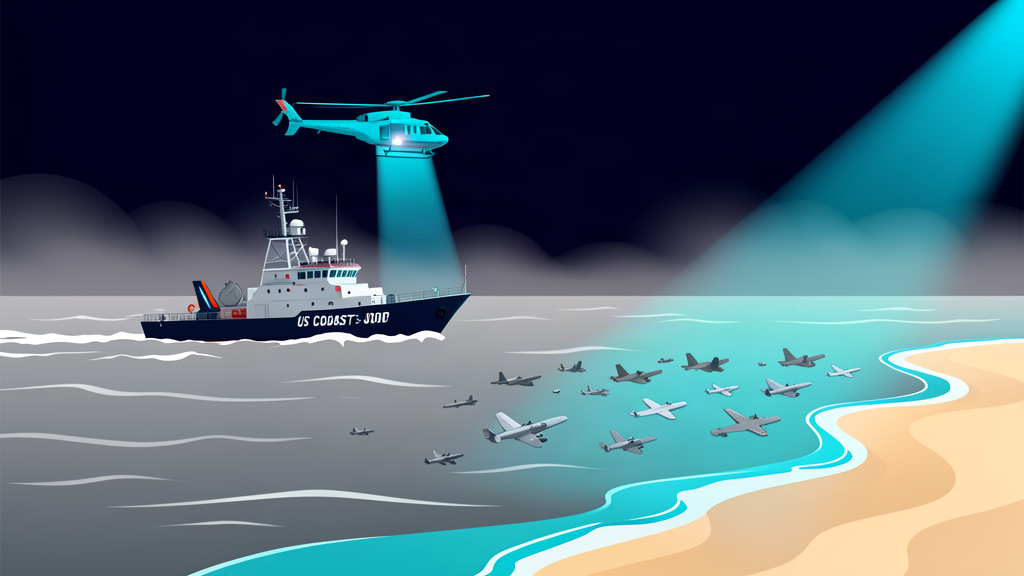
The US Coast Guard has suspended its search for six people aboard a medical transport jet that crashed while flying from Bermuda to Boston, ending a 66-hour operation that covered more than 4,445 miles by air and sea. The coastguard confirmed that debris found off the shore of Nantucket Island, Massachusetts, came from the aircraft. Rear Admiral Matthew Lake, commander of the coastguard’s Northeast District, said at a Sunday news conference that suspending a search “is not an easy decision”.
What was aboard
The aircraft was a Gulfstream G100 registered as Heartbeat 104, operated by Latitude Air Ambulance, a Canada-based medical evacuation and repatriation company. It had flown to Bermuda to collect a patient before heading to Boston Logan International airport. On board were two pilots, two medical staff, a patient and a relative, Clarence Togeretz, the company’s director of flight operations, who told Canada’s public broadcaster CBC about the crew.
The four crew members were Canadian and the two passengers were Bermudian, according to authorities. In a statement on Sunday, Latitude Air Ambulance said that given the information shared by authorities and the conclusion of the search-and-rescue phase, the company must “now face the heartbreaking reality” that the four members of its team, its patient and the patient’s family escort are presumed to have died. The company said its missions are normally staffed by two pilots and medical personnel.
The final minutes
Attention has now turned to what happened in the aircraft’s last moments. Flight tracking data showed a steep descent, and air traffic controllers struggled to re-establish contact. The Federal Aviation Administration alerted the coastguard at around 2am on Saturday, at about 06:00 GMT, after contact with the jet was lost. Lake said the water around the debris was about 80 to 90 feet, or 24 to 27 metres, deep.
Authorities have not determined what caused the aircraft to come down. Medical air ambulance flights carry a particular set of risks: they fly long routes, often at night, and they carry people whose condition can change in the air. Whether weather, mechanical failure, crew fatigue or something else is responsible remains the subject of the investigation.
Why it matters
Losing an air ambulance with a patient aboard is a rare and severe category of accident, and the fact that the aircraft was returning a patient to the United States for treatment means the passengers were already in a vulnerable position. The loss of an entire clinical crew compounds that, since such operators rely heavily on a small number of specialist individuals.

ADVERTISEMENT
There is also a question about search-and-rescue policy. After 66 hours and a wide sweep of air and sea, the coastguard called the search off, and the decision rests on the judgement of commanders weighing probability of survival against the risk to those searching. That judgement will be scrutinised, as it is in every case where a search ends without survivors.
What happens next
The investigation into the cause of the crash will be led by US authorities, with Canada and Bermuda participating given the nationalities involved and the flight’s routing. Families of the six will be the focus of official attention in the coming days. For Latitude Air Ambulance, the immediate priority is the families of its own staff, while the wider medical evacuation industry will be watching the findings for any lessons about night flying, route planning and on-board medical emergencies.


















We do not allow links of any sort in comments. No SPAM whatsoever. On topic comments only.