

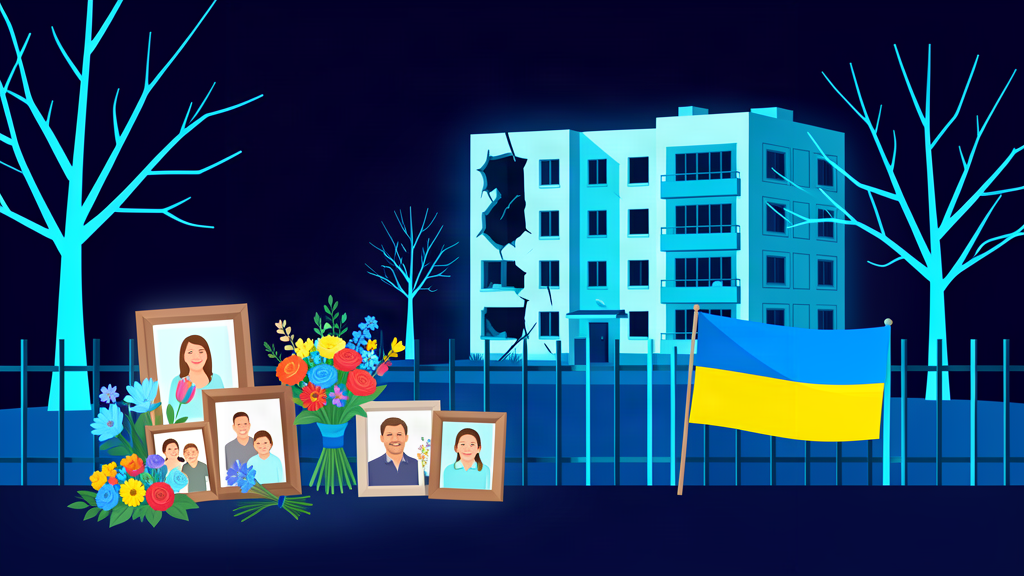
A BBC journalist has investigated the deaths of her own father and grandparents in Ukraine, in a search for answers that she says resists any simple account. Anastasiya Gribanova’s mother came to blame President Volodymyr Zelensky’s troops, but the reporting, published by BBC News, points towards a far more complicated reality than a family’s grief could easily accommodate.
A question with no easy answer
The power of this account lies in the gap between what a family needs to believe and what the available evidence can support. When people are killed in a war, those left behind look for someone or something to hold responsible. In this case, the explanation that took hold within the family placed the blame on Ukrainian forces. Gribanova’s investigation asks whether that explanation survives scrutiny, and in doing so she takes on a role that is uncomfortable for any journalist: examining a story in which she is personally implicated.
BBC News presents the result as an investigation rather than a verdict. That distinction matters. Establishing how people died in an active conflict is notoriously difficult. Records are partial, witnesses scattered, and the fog of war is not a metaphor but a practical condition in which even basic facts can be contested for years. A reporter who is also a family member brings unusual determination to that task, but also an unusual burden: every finding carries a personal cost.
Bearing witness in a war of narratives
Wars are fought with stories as well as weapons. Each side presents casualties in ways that serve a narrative, and audiences thousands of miles away are asked to choose between competing versions. Against that backdrop, an attempt to establish what actually happened to one family is a small but meaningful act. It refuses to treat the dead as symbols and insists that the details of individual lives still matter.
For British readers, there is a second layer. The UK has been a long-standing supporter of Ukraine, and public understanding of the conflict is shaped by reporting from the ground. Stories like this complicate the clean lines of that support without undermining it. They remind audiences that behind every strategic analysis are households whose members are trying to make sense of an unfathomable loss.
Why it matters
The conflict in Ukraine will eventually be assessed in terms of treaties and territories, but its human consequences will outlast any settlement. Investigations that try to establish the truth about individual deaths serve a purpose that goes beyond the courtroom: they give families something firmer than rumour and give history a more honest record. They also demonstrate why independent reporting remains necessary when the information surrounding a war is saturated with competing claims.

ADVERTISEMENT
What happens next
Gribanova’s account is a piece of journalism rather than an official finding, and it is unlikely to provide the definitive legal answer her family sought. BBC News will continue to report on the conflict and on the longer work of documenting casualties. What this investigation does offer is a method: check the evidence, question the comfortable story, and accept that the truth may be harder to bear than either side’s version of events.
Source: BBC News. Read the original report at BBC News →


















We do not allow links of any sort in comments. No SPAM whatsoever. On topic comments only.