

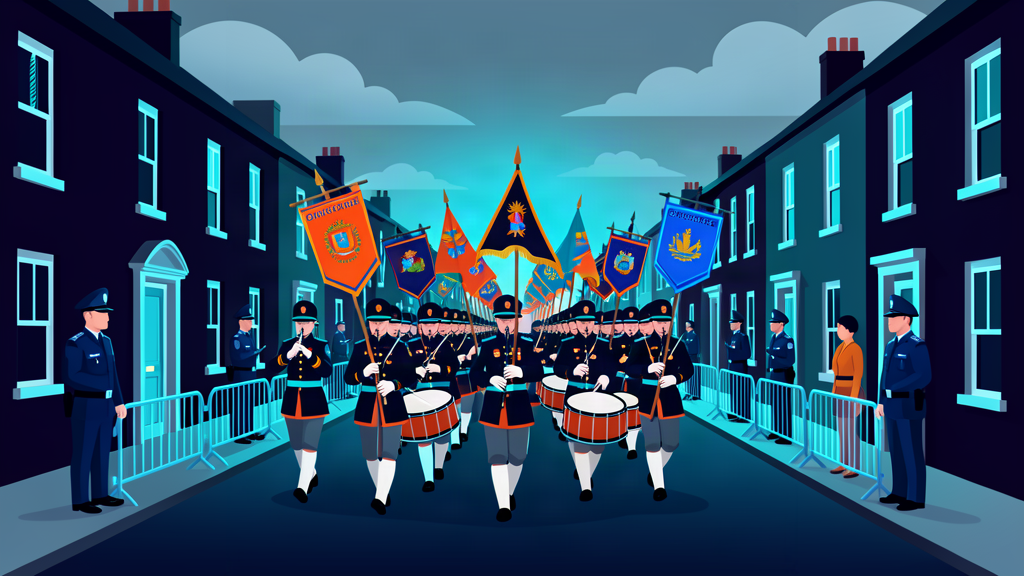
Members of the Orange Order will be permitted to march along Garvaghy Road in Portadown on Sunday after the Court of Appeal overturned a decision to ban the procession through a predominantly nationalist area of Northern Ireland. The ruling means that a parade that had been blocked on public order grounds will now go ahead, reigniting tensions that have marked the Drumcree area for decades.
The loyalist Orange Order had appealed against the original decision to stop the march, arguing that the restriction was disproportionate. The Court of Appeal agreed to overturn the ban, clearing the way for the parade to proceed along the contested stretch of road on its way to and from the Drumcree church. The decision is one of the most significant developments in the long-running Drumcree dispute, where the right of Orange Order marches to pass through the Garvaghy Road area has repeatedly led to standoffs, policing controversies, and community conflict.
The background to Garvaghy Road
Garvaghy Road sits at the heart of one of Northern Ireland’s most persistent parade disputes. The road leads to the Catholic Church of the Sacred Heart, and the local nationalist community has long objected to Orange Order parades passing along it, particularly on Sundays and around the Twelfth of July. For its part, the Orange Order maintains that it has a historical right to march along routes that its members have used for generations, and that any attempt to block those routes infringes on their freedom of assembly.
Over the years, the Drumcree impasse has drawn in the police, the Parades Commission, local politicians, religious leaders, and community representatives from both sides. Some parades have proceeded under heavy policing; others have been blocked; and each outcome has generated its own set of complaints, injuries, and political fallout. The dispute is emblematic of the wider challenge of managing contested parades in Northern Ireland, where historical memory, community identity, and public order intersect at street level.
Why the appeal mattered
The original ban had been imposed on public order grounds, meaning that the authorities judged that allowing the march to proceed would create a risk of serious disorder. When the Orange Order appealed, the Court of Appeal was required to test whether that judgment had been reached on a proper footing and whether the restriction was proportionate to the risk identified. The court’s decision to overturn the ban indicates that it was not persuaded that the original prohibition met that threshold.
That does not mean the court endorsed the parade unconditionally. The ruling concerns the legality of the ban, not the merits of the parade itself, and the police retain their powers to manage the event on the day. Marches in Northern Ireland are policed with complex operational planning, and the presence of opposing communities, political symbolism, and the potential for counter-protests all feed into how the day unfolds.

ADVERTISEMENT
Why it matters
Parade disputes in Northern Ireland are rarely just about the route of a procession. They are about identity, historical grievance, and the limits of what different communities are willing to tolerate on their streets. Garvaghy Road is one of the most charged locations in that landscape, and any decision that allows a march to go ahead there is likely to be viewed very differently by those who welcome the restoration of what they see as a legitimate tradition and those who experience the same event as an intrusion and a provocation.
The Court of Appeal’s intervention also matters for the wider legal framework around parades. It touches on the balance between public order powers and the rights of marchers, a balance that has been contested repeatedly in court, in political debate, and in the work of bodies such as the Parades Commission. How that balance is struck continues to shape the day-to-day reality of community relations in parts of Northern Ireland where the past is still very present on the streets.
What happens next
The immediate question is how the parade itself unfolds on Sunday. Policing plans will be in place, and the authorities will be watching for any attempts to block the route, counter-protests, or disorder. Whatever happens on the day, the underlying dispute is unlikely to be resolved by a single court ruling. Garvaghy Road has been a flashpoint for so long that a changed legal position does not, on its own, settle the deeper disagreement between the communities involved.
In the longer term, the outcome of the appeal may re-open discussion about how contested parades are handled, whether through the courts, through the existing commission system, or through longer-term local dialogue. For now, though, the focus is on Sunday itself and on whether the parade can pass without the kind of confrontation that has marked previous Drumcree standoffs.





















We do not allow links of any sort in comments. No SPAM whatsoever. On topic comments only.