

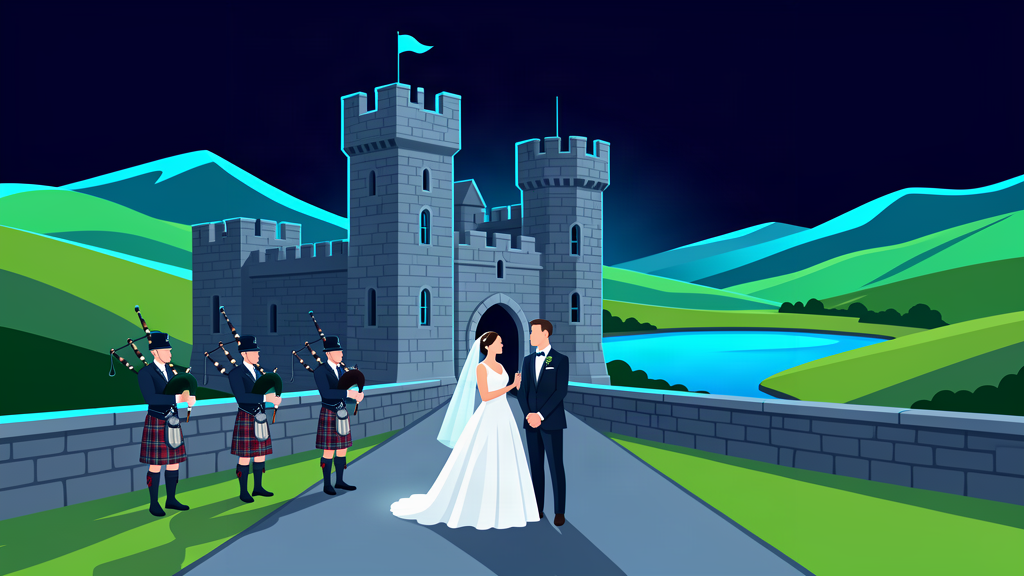
Scotland has become one of the world’s most popular wedding destinations, with official figures showing that nearly a quarter of all marriages registered in the country last year involved couples who did not live there. National Records of Scotland recorded 6,596 of 27,191 weddings in 2025 in which neither partner was a Scottish resident.
Marriages between two Scottish partners remain the largest group but are declining steadily, while marriages where neither partner is Scottish have risen substantially and now make up a much larger share of the total.
Gretna Green and the 1754 tradition
Gretna Green remains the single most popular destination for non-Scots getting married in Scotland. Of the 6,596 marriages involving non-Scottish residents, 3,492 took place in the Dumfries and Galloway town, meaning it alone accounted for more than half of Scotland’s destination weddings.
The town’s association with romance dates back to 1754, when changes to marriage laws in England prompted young runaway couples to cross the border, where they could marry without needing parental consent. That reputation still draws couples from outside the country today.
Angelika and Patryk Klimorowski, both 27, travelled from north-west England to tie the knot at Gretna Green in June. They met at 15 when Patryk’s parents moved from Poland to England, bonding over the 1996 film Loch Ness. Patryk later proposed on the loch’s shores, and the bride walked down the aisle to Flower of Scotland played on the bagpipes.
Castles, islands and ceilidhs
Beyond Gretna Green, couples are drawn to scenery and to a sense of history that is harder to find elsewhere. Hayden Kuhn and Savannah Aanderud, from Pennsylvania, had never visited Scotland before choosing a castle near Edinburgh for their wedding last May. Savannah said the decision came after seeing a castle wedding online. The pair wove Scottish traditions into the ceremony with a Celtic handfasting using fabric from both of their grandmothers, and many of their guests extended the trip into a Highlands honeymoon.

ADVERTISEMENT
Other couples choose the islands and the west coast. Chihon Ley Polanco, from Chile, and Ana-Maria Bucatari, from Moldova, met through a dance society at the University of Edinburgh in 2018 and married on the Isle of Arran four months after getting engaged, with parts of the ceremony translated live into Spanish and Russian for relatives. Their reception included a traditional ceilidh.
Why it matters
For Scotland’s wedding sector the international market is a serious part of the economy, supporting venues, photographers, registrars and tourism operators well beyond Edinburgh and the Highlands. The trend also demonstrates a soft power attraction that operates independently of the country’s core tourism offer.
For UK couples closer to home, the data reflects a domestic shift too. With marriages between two Scottish partners falling as a share of the total, the country’s wedding industry is increasingly catering to a market that has to travel for its ceremony.
What happens next
The next set of annual statistics from National Records of Scotland will show whether the destination-wedding share continues to climb. The industry will continue competing with destinations such as Italy, Greece and Portugal, where prices and legal rules differ, on the basis of heritage, scenery and the accessibility of a legal wedding abroad.





















We do not allow links of any sort in comments. No SPAM whatsoever. On topic comments only.