

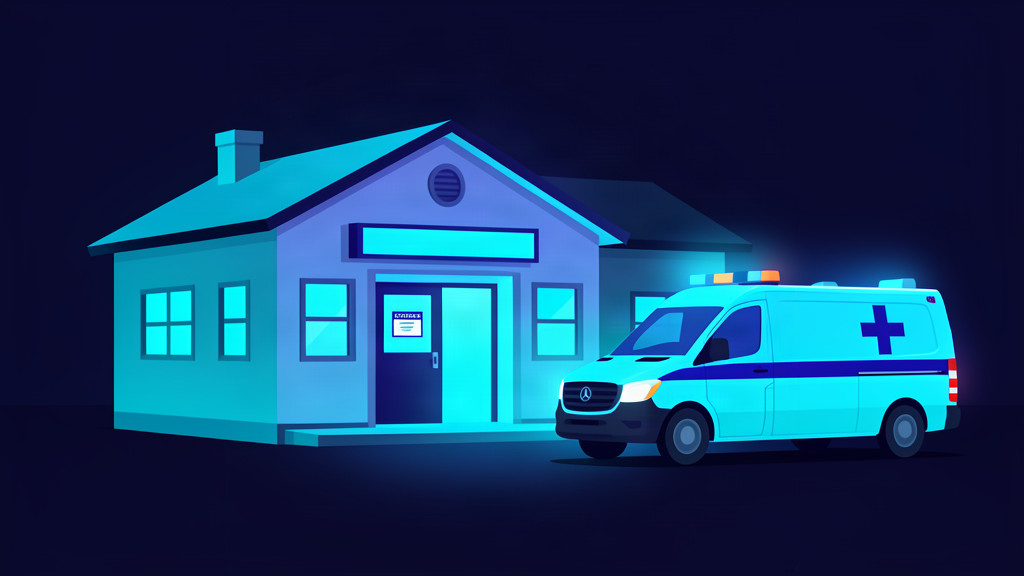
A woman died in a hospital car park after arriving just 11 minutes after its emergency department closed, in a case that has raised fresh questions about access to urgent care in rural areas. Courtney McCowan died in Port Hardy, British Columbia, after paramedics tried to help her outside the hospital, according to a report by The New York Times. The circumstances — a department shut at 5pm, a patient arriving shortly afterwards, and a death in the parking lot — have struck a chord far beyond Canada, because they touch on a dilemma familiar to the UK: what happens to people who need emergency treatment at the very moment local services are unavailable.
What happened
The account, as reported by The New York Times, is stark in its simplicity. The emergency department in question closed at 5pm. McCowan arrived 11 minutes later. Paramedics attempted to treat her in the hospital’s car park, but she died there. The detail that she was outside the building, and that the department had shut only minutes before, has become the focus of the story because it encapsulates a broader problem: emergency care is often organised around fixed hours and finite resources, while illness and injury do not keep to a schedule. For a rural community, the distance to the next open facility can turn a short delay into a life-threatening one.
It is important to be clear about what the report does and does not establish. The New York Times described the sequence of events and the death; it did not, in the reporting summarised here, deliver a finding of negligence or a formal explanation from the hospital. Questions about why the department closed at that hour, what alternatives were available locally, and whether the response was adequate will matter as much as the timing itself. Those questions are likely to be at the centre of any review or inquest that follows.
The rural healthcare problem
Rural health systems face a structural difficulty that urban ones do not. Small populations make it hard to justify round-the-clock staffing of every service, so departments open for set hours and patients must travel or wait when they are shut. In remote parts of Canada, as in the Highlands and Islands of Scotland or rural England and Wales, that can mean long journeys to the nearest open emergency unit. Advances in telemedicine and better triage can help, but they cannot replace hands-on care when someone is critically ill. The result is a persistent tension between financial sustainability and equality of access, with the people who live furthest from services usually bearing the greatest risk.
Why it matters
For UK readers, the case lands close to home because the NHS has wrestled with the same issues for years. Emergency department closures, the centralisation of services and the struggle to recruit staff to remote areas are live political questions in Britain, and ministers have repeatedly promised to improve access while keeping the service sustainable. The Canadian case offers a stark illustration of what can go wrong when the boundaries of a service and the needs of a patient fail to align. It is also a reminder that behind every statistic about waiting times and bed numbers is an individual for whom a few minutes mattered enormously.
What happens next
Attention now turns to how the hospital and local health authority respond, and whether the circumstances will prompt a formal investigation. The New York Times reported the death; any account of what should change will depend on findings that have not yet been made public. For rural communities in Canada and the UK alike, the practical question is how to ensure that someone who falls ill outside working hours can get help quickly enough. That may mean better out-of-hours cover, stronger ambulance provision or smarter use of technology. For now, the case stands as a sobering example of why the question of access is never merely administrative.






















We do not allow links of any sort in comments. No SPAM whatsoever. On topic comments only.