

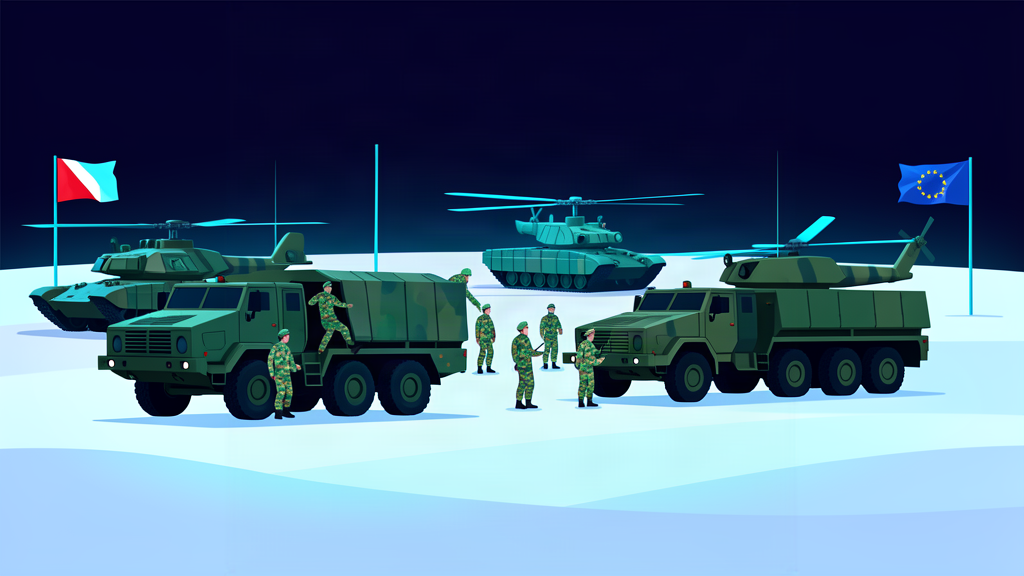
European troops are taking part in military drills in Poland designed to test how quickly they could deploy to Ukraine if a ceasefire is reached, in a sign of the scale of planning under way among Britain’s allies for the period after the fighting stops. According to Al Jazeera, the French- and British-led exercises will test how quickly 2,800 troops from ten European countries could move into position in Ukraine in the event of a ceasefire.
The drills are not a deployment and do not signal that the war has ended. Instead, they are intended to work through the practical questions that would arise if a settlement were agreed, including how forces would be transported, how they would be supplied, how they would coordinate with Ukrainian authorities, and what kind of support they would need on the ground. For the UK, which has been one of Ukraine’s most consistent military backers throughout the war, the exercise is part of a wider effort to ensure that any future security arrangement is credible rather than improvised.
The fact that the drills are being led jointly by France and Britain reflects the central role both countries have played in European efforts to support Ukraine and to consider what comes next. The involvement of ten countries suggests an attempt to build a broad coalition rather than a narrow bilateral presence, which would spread costs and responsibilities and give any future mission greater political legitimacy in Europe.
Planning for an uncertain end to the war
Diplomatic efforts to reach a ceasefire have continued alongside the fighting, but there is no agreed settlement and no timetable for one. Preparing in advance is therefore a hedge against a sudden change in circumstances. If talks were to succeed, the need for monitoring, deterrence and reassurance would be immediate, and a force that had already rehearsed its deployment could move faster and more safely than one starting from scratch.
Such planning also carries risks. Any future deployment would need to be clearly defined, properly authorised under international law, and acceptable to Ukraine itself. The scale of the force, its rules of engagement and its relationship with Ukrainian forces would all be contentious questions. Exercises of this kind allow governments and military planners to explore those questions in advance without committing to a particular outcome.
For Britain, the drills underline how defence policy is increasingly being shaped by the possibility of a long-term European security role. The UK armed forces have worked closely with French counterparts on joint exercises for many years, and the current programme builds on that relationship while adding a specific post-ceasefire scenario that would have been unthinkable before Russia’s full-scale invasion of Ukraine.

ADVERTISEMENT
Why it matters
The exercises show that European governments are moving from supporting Ukraine during the war to thinking concretely about the period after it. A credible post-ceasefire presence could help deter a renewed attack and reassure Ukraine that any settlement would hold, but its effectiveness would depend on unity among allies and on the terms of any peace deal.
What happens next
The drills in Poland will continue testing the deployment concept, while diplomatic efforts for a ceasefire carry on separately. There is no announcement of an actual deployment, and any decision to send troops would depend on the outcome of negotiations and on agreement with Ukraine. For now, the exercises are a measure of how seriously European capitals are taking the need to be ready.
Reporting based on Al Jazeera coverage of the French- and British-led exercises in Poland.
















We do not allow links of any sort in comments. No SPAM whatsoever. On topic comments only.