

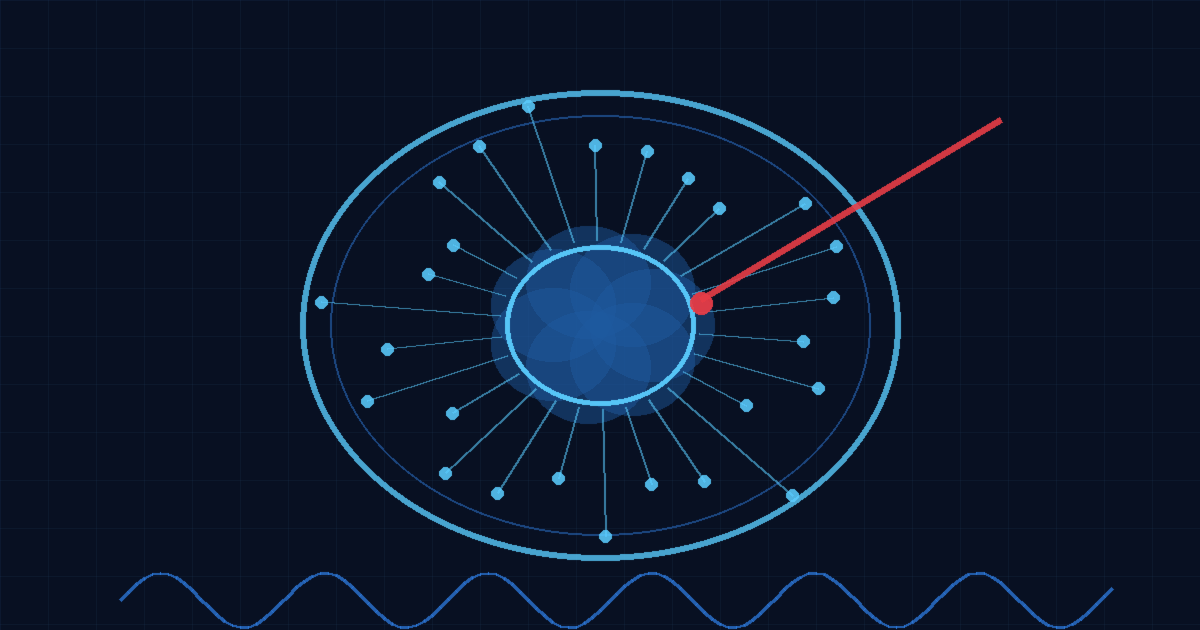
While the tech industry races to scale silicon neural networks, biologists are growing the real thing. Human brain organoids – chia-seed-sized clumps of living neurons grown from ordinary skin cells – are already steering robots through mazes, running early biocomputing chips and learning to play video games. Their backers argue the next generation of intelligence will not be artificial at all.
What a Brain Organoid Actually Is
The recipe is startlingly mundane. Take a sample of adult tissue – skin, blood, hair, even a tooth – and expose the cells to a specific set of proteins that reverts them to an embryonic-like state. Those induced pluripotent stem cells can then be coaxed down almost any developmental path: tear glands that weep, cardiac tissue that beats, or neural tissue that self-organises into a small mass of grey matter. Kept at body temperature for around eight months, these organoids begin producing rhythmic oscillations – brain waves – that researchers describe as close to indistinguishable from those of a premature infant.
Neurons Want to Connect
The reason organoids are easy to make is that neurons are relentlessly social. Left loose in a dish they proliferate and reach for each other, extending axons until they have knitted themselves into autonomous tissue. As UC San Diego developmental biologist Alysson Muotri puts it, whatever environment you place them in, the first thing they try to do is connect – to the dish, to the electrodes, to one another. Organoids largely build themselves.
Inside the Labs Growing Minds in Dishes
At UCSD’s Sanford Stem Cell Institute, organoids are produced in the tens of thousands. Muotri’s lab has revived genetic material from the hominin fossil record to create “Neanderthalised” organoids, and has flown organoid payloads to the International Space Station to study how cosmic radiation affects the astronaut brain. Elsewhere, organoids have been wired into spidery robots and sent through mazes, and dosed with psychedelics to observe the neural response.
Biocomputing: When Wet Tissue Becomes Hardware
The most commercially charged work is happening at the hardware boundary. Johns Hopkins researchers have prototyped “biochips” that integrate living organoids with conventional electronics, and a Melbourne startup has coupled neural cultures to classic games including Pong and Doom. The training method is not backpropagation but stimulus and reward: patterned electrical signals paired with chemical hits of dopamine. Advocates point to the energy argument – a human brain runs on roughly the power of a light bulb, while frontier model training consumes the output of power plants.
The Scale Reality Check
Nobody should mistake this for a threat to GPUs today. A typical organoid in Muotri’s lab holds about 5 million cells, of which roughly 2.5 million are neurons – the rest are glial cells acting as scaffolding. That is, by his own comparison, about the size of a bee’s brain, against the 86 billion neurons of a human. Organoids also lack the layered architecture, sensory input and body that shape a developing brain. They are a research substrate, not a product.

ADVERTISEMENT
The Bioethics Nobody Has Settled
Because organoids are not organisms, they fall into a regulatory blank space. As one UCSD sociologist bluntly noted in the context of invertebrate research, nobody needs permission to torture as many flies as they like – and for now nobody needs permission for organoids either. That framing is comfortable while the tissue is bee-sized and blind. It becomes far less comfortable if organoids grow larger, are cultured longer, or are given sensory channels and feedback loops that make claims about experience harder to dismiss out of hand.
Why Medicine, Not Computing, Is the Near-Term Payoff
The clearest short-term value is not intelligence but disease modelling. Organoids let researchers watch human neural development in real time rather than inferring it from mouse studies, and they can be grown from specific donors. Muotri’s own focus is autism – his teenage son is autistic – and his lab compares organoids grown from autistic and neurotypical donors to locate where developmental trajectories diverge. Toxicology screening and drug testing on human tissue are similarly practical wins.
Outlook
Organoids are not going to replace transformer models this decade, and the “AI is dead” framing is deliberate provocation. But the field is a genuine second bet on how intelligence gets built, funded by very different institutions and constrained by biology rather than by supply chains. The nearer question is governance: research using living human neural tissue is scaling faster than the ethical and regulatory scaffolding around it, and that gap is likely to become the story before any organoid outthinks a neural network.
Source: Original report. Rewrite for Your News Website.















We do not allow links of any sort in comments. No SPAM whatsoever. On topic comments only.