

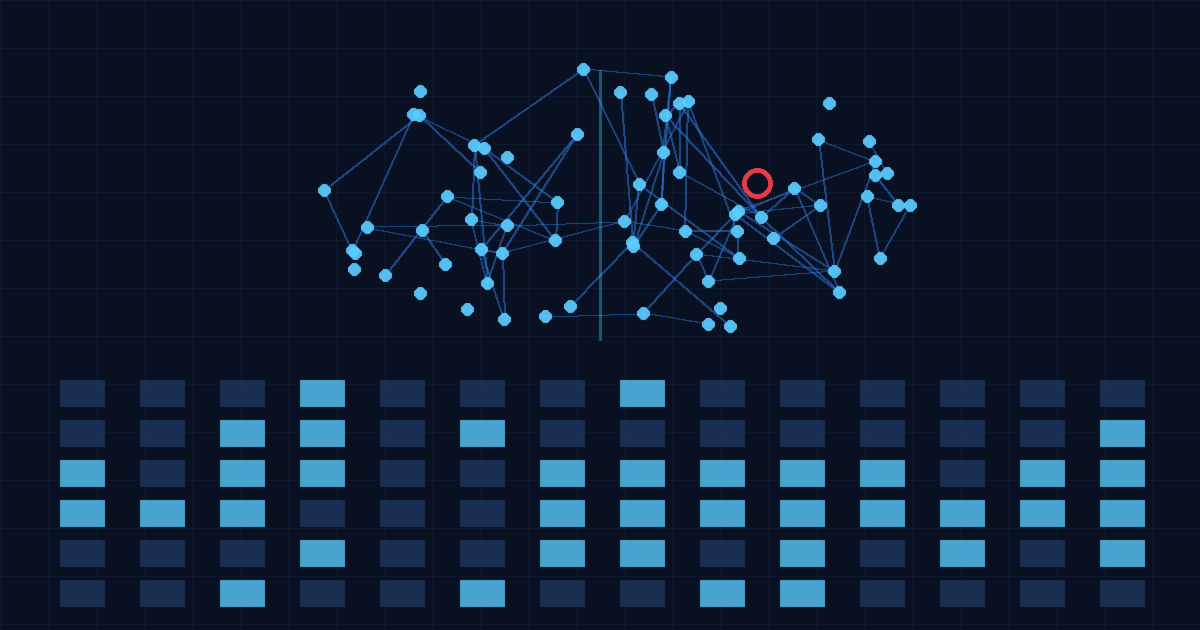
Schizophrenia has resisted genetic explanation for decades because it is not one broken gene but hundreds of small effects acting together. A new Nature Genetics study using AI-based computational models has mapped 766 associated genes – 641 of them never seen in previous transcriptomic work – and shows they behave less like isolated switches than like a wired network.
Why Schizophrenia Broke Traditional Genetics
Single-gene disorders are tractable: find the mutation, trace the protein, target it. Schizophrenia offers no such handle. Risk appears to be assembled from hundreds of variants, each nudging a different biological process – some shaping neural development, others altering how neurons communicate or how brain-wide connections are organised. No individual variant explains much, which is why decades of candidate-gene studies produced a graveyard of weak, unreplicated hits.
What the New Study Found
The team identified 766 genes associated with the disorder, of which 641 had not surfaced in earlier transcriptomic analyses. Many emerged only because the models could pick up long-range regulatory signals – cases where a variant influences a gene sitting far away on the genome rather than the one immediately next to it. That detail matters: it is direct evidence that these genes operate as an interconnected system rather than as a list of independent risk factors.
Turning On the Lights in the Whole Neighbourhood
The researchers’ own metaphor is a street at night. Previously they could see a handful of lit windows and had to guess at the shape of the block. Now much of the neighbourhood is illuminated, and the pattern of which houses light up together becomes visible. Instead of acting separately, the variants appear to coordinate, collectively raising risk.
Where AI Actually Did the Work
It is worth being precise about the role of machine learning here, because “AI solves disease” headlines usually overreach. The models were not diagnosing patients. They were used to reconstruct the coordinated expression activity of thousands of genes across human brain tissue – inferring regulatory relationships and network structure from data far too high-dimensional for conventional statistics. The AI is an inference engine over gene co-activity, and its output is a map for biologists to test.
The Scale of the Dataset
Statistical power is what makes the result credible. The analysis drew on genetic data from more than 102,000 people, combined with post-mortem brain tissue from six distinct brain regions supplied by hundreds of donors. The work involved the Lieber Institute for Brain Development, the University of Bari and dozens of psychiatric research centres across multiple countries – the kind of consortium scale that has become the price of entry in polygenic psychiatry.

ADVERTISEMENT
What This Means for Patients
The World Health Organization estimates schizophrenia affects roughly 23 million people worldwide, about one in every 345. The condition alters perception of reality, typically through hallucinations and delusions, and often brings social withdrawal, loss of motivation, and problems with attention, memory and thought organisation. Family history raises risk without determining it: some people with affected close relatives never develop the disorder, while others are diagnosed with no known family history at all – a pattern that only makes sense if many small contributions are being summed.
Not a Test, Not Yet a Treatment
Nothing here delivers a diagnostic panel or a drug. What it delivers is a shortlist of candidate mechanisms and, crucially, network hubs – points where interference might affect many downstream processes at once. Given that current antipsychotics still largely target the same neurotransmitter pathways identified generations ago, a set of genuinely new biological entry points is significant on its own.
Outlook
The next phase is validation: confirming these 641 newly implicated genes in independent cohorts, in cell models and in organoid systems, and checking that findings drawn largely from European-ancestry datasets generalise across populations. If the network picture holds, the field’s ambition shifts from hunting a cause to modulating a system – a slower, less satisfying story than a single culprit gene, but one far closer to how the disorder appears to actually work.
Source: Original report. Rewrite for Your News Website.


















We do not allow links of any sort in comments. No SPAM whatsoever. On topic comments only.