

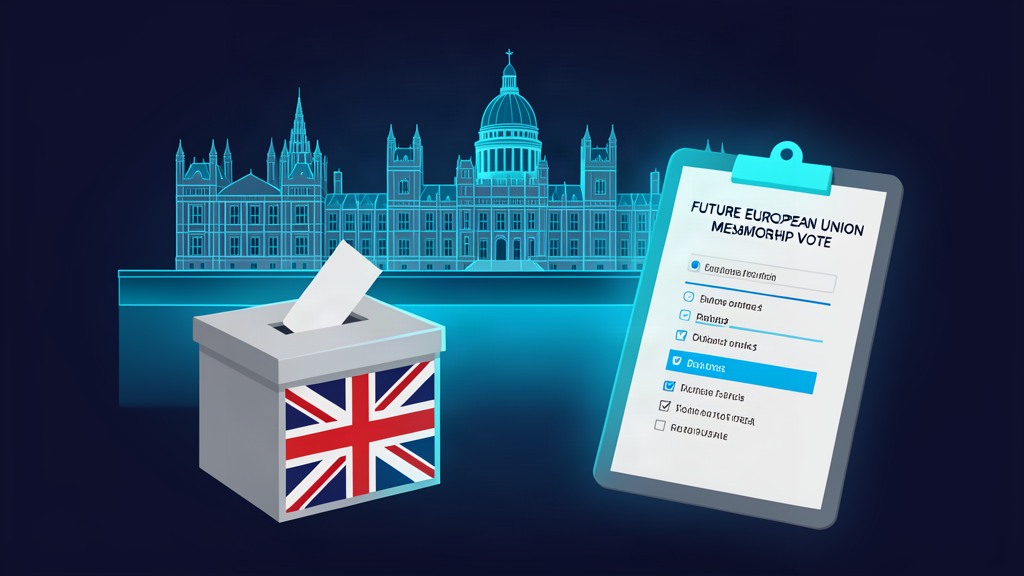
The Prime Minister has told the BBC that a new referendum on Britain’s relationship with the European Union could appear in Labour’s next election manifesto, while insisting that holding one now would not be the right thing for the country.
A Brexit referendum in the manifesto, but not now
Andy Burnham said the Labour Party is prepared to include a commitment to a further referendum on EU membership in its next general election manifesto, framing it as a way of settling the long-running question in a democratic way. At the same time, he made clear that a vote should not be held immediately, arguing that the country is not in a position where a referendum would be appropriate at this point.
The comments place the Prime Minister in a careful position on one of the most divisive issues in modern British politics. Brexit remains a live subject for many voters, with opinion divided between those who want to re-join the EU, those who want to improve the post-Brexit relationship, and those who regard the matter as settled. By signalling that a referendum could be in the manifesto without committing to an immediate vote, the Prime Minister is attempting to acknowledge the continuing debate without triggering a fresh confrontation over the issue.
Why Labour is signalling a referendum option
For a party that has, in this timeline, returned to government under Andy Burnham’s leadership, the question of Europe cannot be ignored indefinitely. The electoral landscape includes voters who feel that Brexit did not deliver what they expected, as well as those who voted to leave and resent any suggestion that the decision should be revisited. A manifesto commitment to a referendum, without a date or a predetermined outcome, is one way of acknowledging both camps without forcing a decision now.
It also reflects the political reality that the issue has not gone away. Years after the 2016 referendum and the subsequent departure from the EU, Britain’s relationship with Europe continues to shape debate on trade, migration, regulation, and cooperation. By flagging a possible referendum in the next manifesto, Labour is signalling that it sees the question as ultimately one for the electorate to resolve again, rather than one for ministers to settle by policy adjustment alone.
The case against an immediate vote
The Prime Minister’s insistence that a referendum is not the right thing now is significant. It suggests that the Government believes the country faces more immediate priorities, and that a fresh EU vote would be a distraction or a destabilising event at a time when other challenges demand attention. That argument is likely to resonate with voters who are tired of the Brexit debate and want focus on the cost of living, public services, and economic growth.

ADVERTISEMENT
But the position also carries risks. Those who want to rejoin the EU may feel that Labour is leaning too far away from their priorities, while those who supported Brexit may see any promise of a future referendum as a breach of the 2016 result. Walking that line is difficult, and the Prime Minister’s comments are likely to be scrutinised from both sides of the argument.
Why it matters
Europe remains one of the deepest fault lines in British politics. A party that hopes to command a stable majority over time cannot simply wish the issue away, and a manifesto commitment to a referendum is one way of addressing that reality. Whether such a commitment would help or hurt Labour in the next election depends heavily on how it is framed, how much prominence it is given, and what else is in the manifesto.
The Prime Minister’s remarks also matter because they signal how the Government is thinking about the longer arc of Britain’s relationship with Europe. A future referendum, if it were ever held, would be a major national decision with economic and constitutional consequences. Even the suggestion of such a vote reshapes the political conversation and forces other parties to set out their own positions.
What happens next
The Prime Minister’s comments are likely to prompt discussion inside Labour about what a manifesto commitment on Europe would look like, how it would be worded, and whether it would be prominent or buried. The party’s position may evolve as the election approaches and as the political context changes.
For now, the signal is that a referendum is possible in principle but not imminent in practice. That leaves the question open, and it is likely to remain a subject of debate among MPs, activists, and voters until the manifesto is finally published.
Source: BBC News. Read the original report at BBC News.























We do not allow links of any sort in comments. No SPAM whatsoever. On topic comments only.