

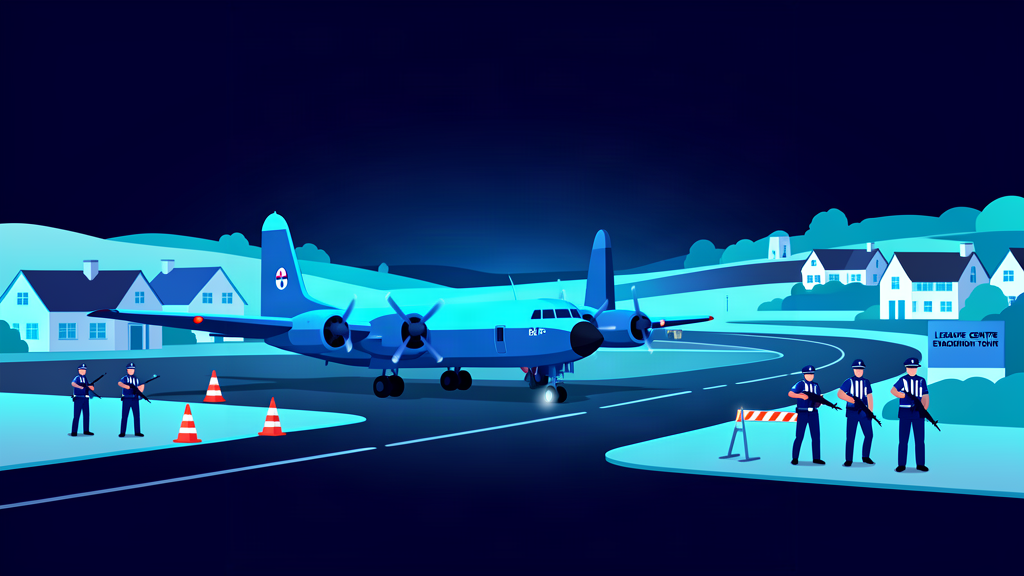
RAF Fairford, a former Cold War base in a quiet corner of Gloucestershire, is now the centre of a counter-terrorism investigation that has drawn statements from Washington, Tehran and Downing Street. It began, according to the New York Times, with a single call in the early hours of a Sunday: a farmer reporting masked men and three vans heading towards the base.
British counter-terrorism detectives arrested five men on suspicion of explosives and terrorism offences. A major incident was declared, residents of nearby Cirencester were directed to a leisure centre used as an evacuation point, and a 400m cordon and bomb disposal robot followed. No explosives were found in the vehicles. The five men, all in their twenties, were released on bail.
An ally’s war on a doorstep
The base has flown from Fairford for decades, and the UK authorised US bombers to use it for strikes on Iranian missile sites. That decision turned a piece of Gloucestershire farmland into a target in someone else’s war. As one local shopkeeper put it to BBC reporters, much of the uncertainty in the village has come from the realisation that people here live beside an airbase currently bombing another country.
Prime Minister Andy Burnham said he knew the incident would be deeply concerning for local residents and for people following developments across the country. He has since said there are “strong indications” that Iran played a part in what happened, while stressing the investigation remains complex and serious. Tehran issued a forceful denial.
A foreign actor, or not?
US secretary of state Marco Rubio said the incident “clearly involves the hands of a foreign actor”. The head of counter-terrorism policing has said detectives are looking at the case from “every possible angle”, including the possibility that those present were acting knowingly or unknowingly on behalf of a foreign state. A dual British-Iranian national was later arrested in London on suspicion of preparing terrorist acts.
Because criminal proceedings are active, police have said little. The central unknown is whether the men in the vans were participants, dupes, or simply in the wrong place, and whether anyone directed them.

ADVERTISEMENT
Why it matters
The investigation is a test of a compromise Britain made when it agreed to host American strikes. Hosting means taking a share of the consequences: the security operation, the disruption, and the diplomatic heat, all landing on a village rather than on a ministry. A foreign state apparently operating on British soil, at a base used to attack it, is a scenario UK counter-terrorism planners will now have to treat as a real possibility rather than a theoretical one.
What happens next
Investigators will work through mobile phones, computers and premises searches to establish who directed the men in the vans. The Metropolitan Police inquiry into the arrest in London continues in parallel, and Britain’s engagement with Tehran will be tested by how far investigators are willing to go publicly.

















We do not allow links of any sort in comments. No SPAM whatsoever. On topic comments only.