

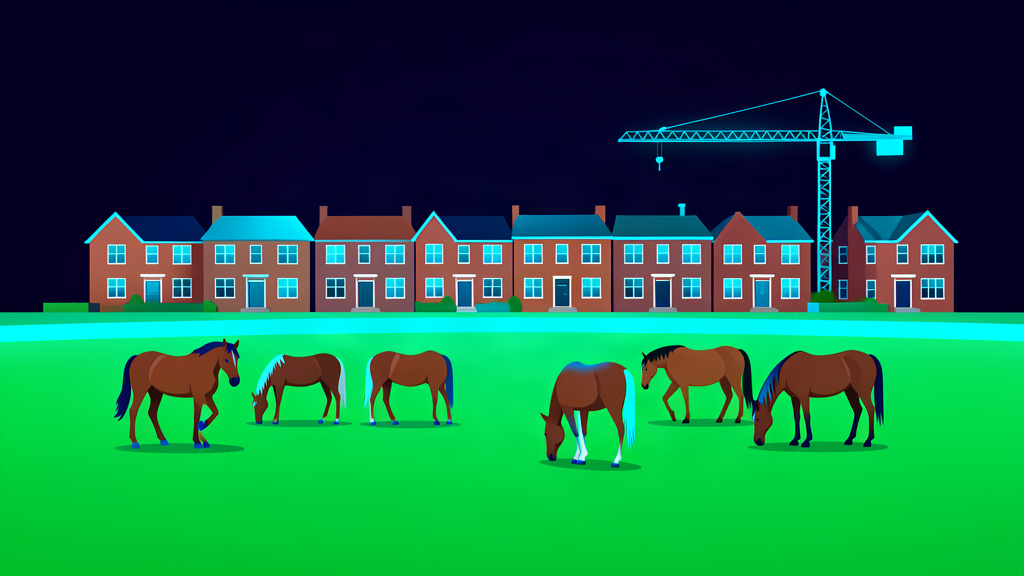
A handful of horses grazing on land earmarked for housing has become an unlikely window into England’s chronic shortage of homes. In Middlesbrough, York and Kent, the BBC looks at why successive governments have failed to build enough houses, and the answer lies less in any single policy than in a tangle of local obstacles, competing interests and long delays. The image of animals standing on potential building land captures a frustration that has built up across the country: sites sit idle while the need for homes keeps growing.
The land that stays empty
On the surface, the solution to a housing shortage seems simple: find land and build on it. In practice, the land that could be developed is often the subject of disputes that can last for years. Owners may be unwilling to sell, local plans may lag behind, and communities may object to changes in the place they live. Where a site is allocated for housing on paper, the gap between that decision and actual bricks on the ground can be surprisingly long. The six horses are a symbol of that gap, a piece of land with a housing label that has yet to become a neighbourhood.
Why homes are not getting built
The BBC’s tour of three very different places suggests there is no single culprit. Planning rules, infrastructure, the availability of builders and the willingness of councils to push schemes forward all play a part. A site may be allocated but lack the roads, schools or drainage that make it viable. A developer may be ready but deterred by costs. Local opposition, often reasonable when framed as protecting green space or traffic, can slow a project even when the national case for building is strong. The result is a system that delivers far fewer homes than the country’s ambitions assume, year after year.
Why it matters
Housing is not an abstract statistic. Behind the debate are young adults priced out of buying, families stuck in rented homes, and people waiting years for a council property. When supply falls short of demand, prices and rents rise, and the strain shows up in household budgets and in the places people can afford to live. Successive ministers have promised to build more, yet the gap persists. That gap shapes who can start a family, who can move for work and, over time, the balance of opportunity between different parts of England.
What happens next
The question for ministers is how to turn allocated sites into finished homes faster. That may mean simplifying planning, investing in infrastructure ahead of development, or reforming the way land is brought forward. Each option carries trade-offs, and none will satisfy every local objection. What the horses in Middlesbrough, York and Kent illustrate is that the crisis is as much about delivery as it is about ambition. Until the gap between a planning map and a finished street narrows, England will keep building far fewer homes than it says it needs.



















We do not allow links of any sort in comments. No SPAM whatsoever. On topic comments only.