

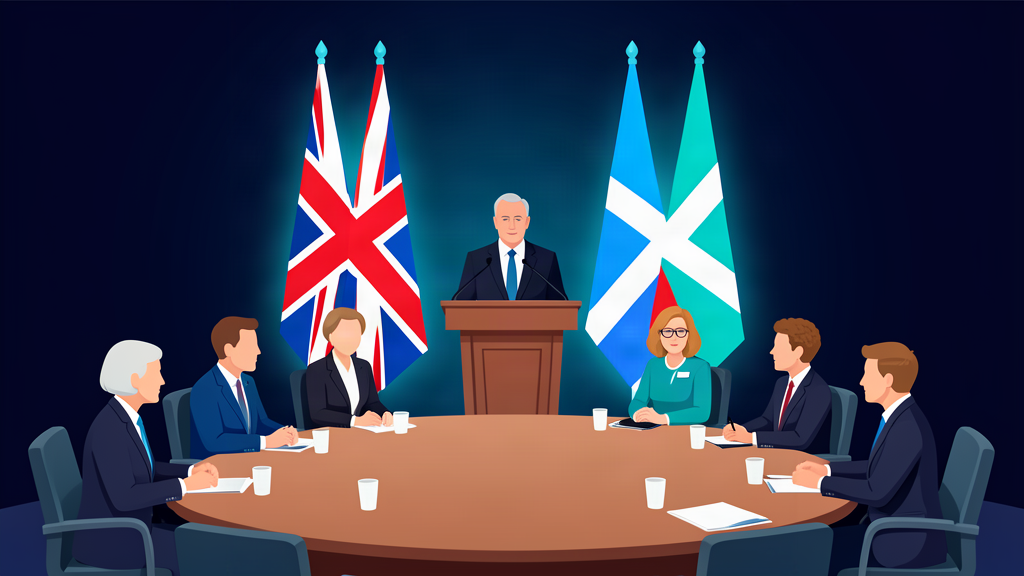
Prime Minister Andy Burnham has convened the first ministers of Wales, Scotland and Northern Ireland for a formal summit, choosing his inaugural official visit to Wales since taking office to reset the tone of relations between Westminster and the devolved governments. The gathering, announced as Burnham met Welsh leaders in Cardiff, is the clearest signal yet of how the new administration intends to manage the United Kingdom’s increasingly complex constitutional settlement.
A summit on home soil
According to the BBC, the announcement came as the Prime Minister carried out his first official trip to Wales since becoming prime minister. Rather than holding the meeting in London, Burnham has taken the discussion to Cardiff, a deliberate break from the habit of summoning devolved leaders to Whitehall. The Welsh, Scottish and Northern Irish governments each control substantial portfolios — health, education and transport among them — that touch everyday life across the four nations, and decisions taken in isolation in one capital routinely ripple into the others.
Why devolved relations matter now
The United Kingdom has run a devolved system since the late 1990s, with the Senedd in Cardiff, the Scottish Parliament in Edinburgh and the Northern Ireland Executive in Belfast each elected on distinct mandates. Funding flows, welfare boundaries and infrastructure programmes are frequently the subject of friction, and previous administrations have been criticised for treating the devolved governments as an afterthought. A summit of this kind gives the four heads of government a single forum to align on priorities that cross borders — from energy security to cross-border NHS pressures.
Why it matters
For households, the practical stakes are concrete. Where the UK government and the devolved administrations pull in different directions, public services can become uneven, and major projects — rail links, grid upgrades, flood defences — can stall in disagreement. A working relationship at the top reduces the risk of duplication and ensures that decisions taken in one nation are not quietly undermined by another. It also sets the political weather: a constructive summit lowers the temperature of the perennial arguments over who controls which levers of power.
What happens next
The immediate question is whether the summit produces a formal communiqué or a standing mechanism for regular first-minister meetings, rather than the ad-hoc calls that have characterised recent years. Observers will watch for any agreement on shared spending priorities and for signs that the Northern Ireland Executive — restored only after a prolonged stalemate — is being brought fully into the fold. Burnham’s decision to open the conversation in Wales suggests a willingness to lead from the regions, but the real test will be whether today’s goodwill survives the next round of budget negotiations.
Source: Original report. Rewrite for Your News Website.

















Really helpful article, thank you – looking forward to more like this!