

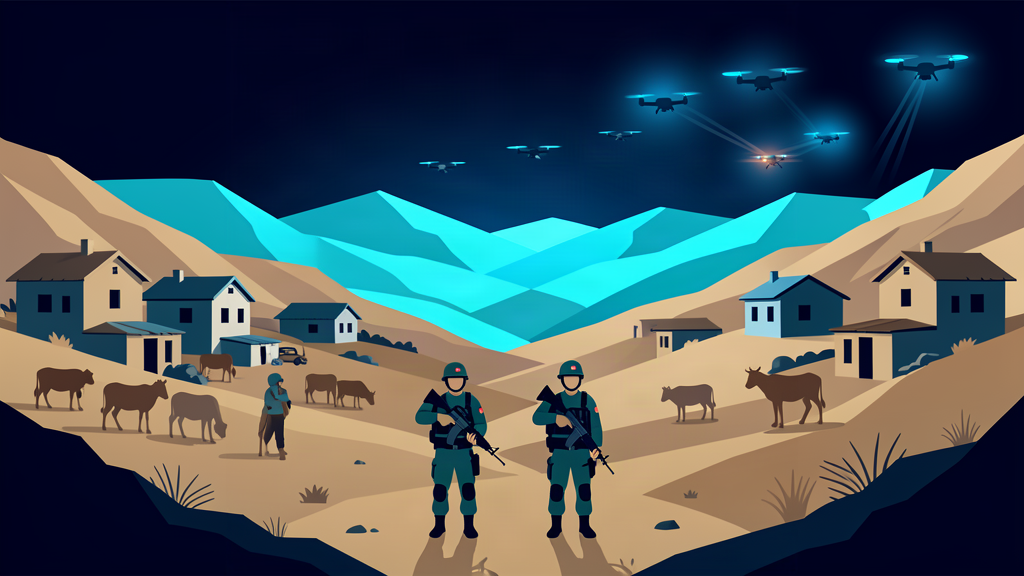
Yemeni government forces backed by Saudi Arabia are battling to push back Houthi fighters who have swept down the Red Sea coast, seizing the strategic port of Mokha and tightening their grip on the surrounds of Taiz, the country’s third-largest city.
A front line in the mountains
The fighting around Taiz has intensified sharply since the Houthis captured Mokha on 10 September, ending a four-year ceasefire that had largely held across the civil war. From the mountains south-west of the city, the front line is hard to pin down — homes are scattered across the slopes, many abandoned after families fled the shelling and gunfire. All that remains audible in the otherwise silent hills is the bleating of livestock and the thud of incoming and outgoing fire.
Saudi-backed pro-government forces are dug in on the high ground above the western approaches to Taiz, contesting the ridges that overlook the road south. If the Houthis secure those positions, government forces could find it far harder to retake Mokha — and with it, control of the corridor to the Bab al-Mandab Strait, the crucial shipping chokepoint linking Europe and Asia.
The Houthis are making extensive use of drones alongside mortars and other weapons in the offensive. Their main outside supplier is Iran, which Saudi Arabia, Western countries and UN experts say provides weapons, funding and military advice. Iran has previously denied arming the Houthis and says it offers only political support.
Civilians caught in the crossfire
At al-Thawra hospital in Taiz, casualties from the front lines are arriving in numbers that have left every bed in the intensive care unit occupied. Among them is 12-year-old Ghana Nabeel, who was herding goats when shrapnel from a Houthi mortar struck her head. A doctor told reporters the injury had damaged her brain and that she would never be the same again.
Further south at the al-Monig displacement camp, families who fled Mokha and villages hit by fighting continue to arrive among hundreds of tents. One woman, who gave her name only as Maryam Saleh, walked barefoot with her husband and five children after fleeing Mokha a week earlier. Her nephew was killed by mortar shrapnel as the family walked, she said.

ADVERTISEMENT
Another displaced woman, Fatma Mohammed Saleh, cannot walk and said she had spent two days crawling on her hands and knees through incoming bullets and shells before a motorcyclist picked her up and drove her to the camp. She has not seen her family since.
The UN refugee agency said on 22 September that more than 130,000 people had been displaced across Yemen so far that month, on top of 5.2 million already uprooted by the civil war. It warned that another 100,000 could be forced from their homes over the following three months.
Why it matters
The Houthi offensive around Taiz and the Red Sea coast is the sharpest escalation in Yemen’s civil war in four years. The group’s control of the Bab al-Mandab Strait — through which a significant share of global maritime trade passes — has already contributed to a rise in oil prices as fears grow of further disruption to supplies from the region. A collapse of the ceasefire and the possibility of a broader regional confrontation involving Iran, Saudi Arabia and its allies are now live concerns.
For the UK, the instability touches several interests: unhindered passage through the Red Sea for British shipping, the safety of any UK nationals in the region, and the wider question of whether the conflict could draw in Western powers once again, as it did during the 2015 intervention.
What happens next
Government forces and Houthi fighters are both said to be preparing for a major offensive. Contacts from the Houthi side have told BBC reporters they are consolidating troops. Government forces say they are aware of the buildup and preparing in turn. The UN has warned of further displacement in the coming months. The international community, including the Saudi-led coalition backing the Yemeni government, faces decisions about whether to escalate military support or push harder for a renewed ceasefire — and the fighting around Taiz will likely shape which path prevails.
Source: BBC News, 27 September 2026. Reporting by Nawal Al-Maghafi with additional reporting by Jasmin Dyer.



















We do not allow links of any sort in comments. No SPAM whatsoever. On topic comments only.