

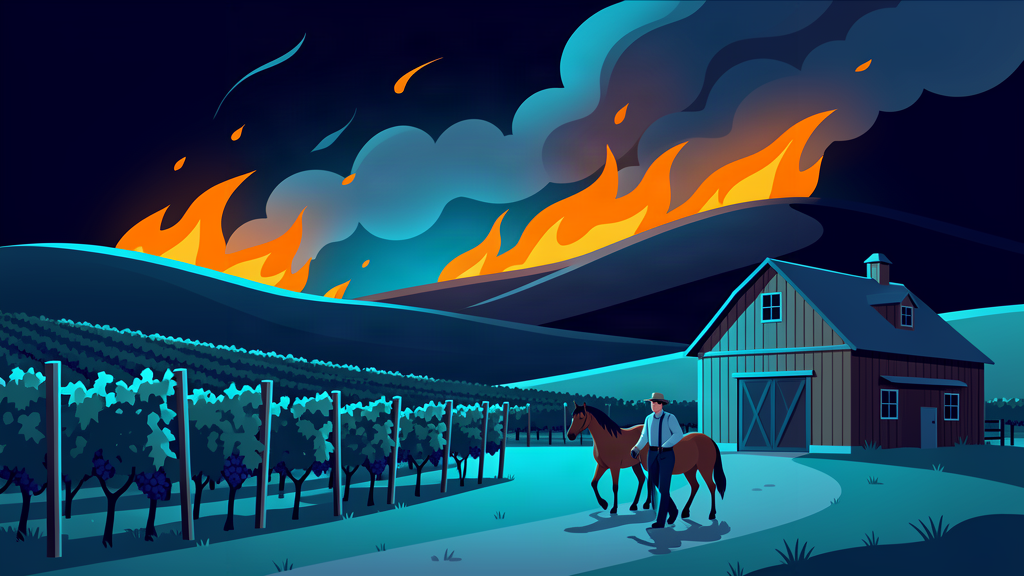
Wildfires tearing through British Columbia have forced winemakers and cattle ranchers from their land, with the damage set to ripple through global wine supply — including onto UK shelves.
British Columbia’s wine and ranching country under fire
Winemakers and ranchers across British Columbia are fleeing fast-moving wildfires that have swept through the province’s interior valleys, leaving vineyards scorched, herds displaced and an agricultural sector facing an uncertain future. The fires have hit the Okanagan and surrounding valleys — the heart of Canada’s premium wine production and a significant cattle-rearing region.
For growers, the destruction is only part of the story. Even vines that survive the flames can be ruined by smoke taint, in which volatile compounds from wildfire smoke are absorbed by grape skins and later produce an ashy, acrid character in the finished wine. Entire harvests can be written off after laboratory testing, months after the fires have been extinguished.
What it means for UK wine buyers
British Columbia is a modest but growing presence on UK wine lists, particularly in the premium and independent merchant segment. Repeated fire seasons have already tightened supply and pushed prices upward. UK importers who built relationships with Okanagan producers now face a familiar dilemma: absorb higher costs, pass them to consumers, or switch sourcing to other regions.
The wider lesson lands closer to home. English and Welsh vineyards have expanded rapidly on the back of warming summers, and UK producers have watched climate-driven disruption in Australia, California and now Canada with a mixture of opportunity and alarm. The same warming that has made southern England viable for sparkling wine is destabilising established wine regions worldwide — and no producer is permanently on the winning side of that trade.
Ranchers face a longer recovery
For cattle ranchers, the immediate task is evacuating livestock, often across roads already closed by fire. The harder problem comes afterwards: burned rangeland can take several seasons to recover, forcing ranchers to buy in expensive feed or reduce herd sizes. Insurance rarely covers the full economic loss, and many family operations that have farmed the same land for generations are now questioning whether they can continue.

ADVERTISEMENT
Insurance and the cost of a warming climate
Insurers have progressively withdrawn or repriced cover in high-risk wildfire zones across North America, a pattern also emerging in flood-prone areas of the UK. The parallel matters: when private insurance retreats, governments face pressure to backstop the risk, and the fiscal cost of climate adaptation moves from the household to the taxpayer.
A pattern, not an event
British Columbia has now endured a series of severe fire seasons, punctuated by heat domes and drought. Scientists have consistently linked the intensity and length of these seasons to rising global temperatures. For the growers loading what they can into trucks and driving away from their vines, the debate is academic — but the question of whether to replant, and where, is entirely practical.
Source: Reuters (GNews) – original report
Source: Original report. Rewrite for Your News Website.





















We do not allow links of any sort in comments. No SPAM whatsoever. On topic comments only.