

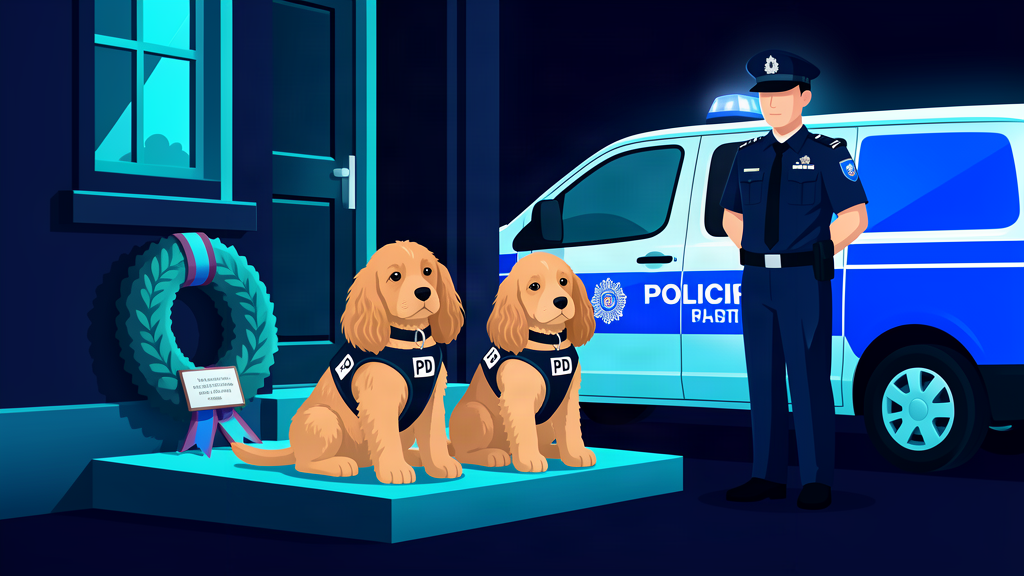
Two five-month-old cocker spaniels have been given the names of officers who lost their lives in a crash, in a tribute that will carry their memory into the daily work of a British police dog unit. Cleveland Police’s dog unit has named the puppies PD Bladesy and PD Tommy, according to the BBC. The decision turns a pair of young recruits into a living reminder of colleagues whose service ended suddenly, and it reflects a tradition across UK policing of finding ways to keep the names of the fallen in active use rather than consigning them to a plaque alone.
Names with a working purpose
Police dogs are not ceremonial animals. They are trained to work alongside handlers in demanding conditions, and the names they carry become part of the language of a shift: called out over radios, written into logs and spoken by colleagues who never knew the person the dog was named after. Choosing the names of officers who died in a crash gives that everyday routine a deeper meaning for the force and for the families left behind.
The BBC report identifies the dogs as cocker spaniels, a breed increasingly favoured in British policing for its trainability, size and temperament. Their age matters too. At five months, the puppies are at the beginning of a long training journey, and the unit will be hoping that the association with two former colleagues becomes a source of pride as they grow into their roles. Naming them at this stage means every stage of their development, from early obedience work to operational deployment, will carry the tribute with it.
A wider tradition of remembrance
Across the United Kingdom, emergency services have found similar ways to mark the loss of colleagues. Forces name buildings, boats, horses and sometimes operational assets after those who died, so that remembrance is woven into working life rather than confined to an annual service. For Cleveland Police, an area with a strong local identity and close-knit policing communities, the choice is likely to resonate well beyond the dog unit itself.
Families of officers who die in the line of duty often say that what sustains them is the knowledge that their relative has not been forgotten. A dog responding to a name on a busy street or at a public event is a quiet but visible way of keeping that promise, and one that reaches parts of the community a formal memorial might not. It also gives current officers a tangible link to colleagues they may only have heard about in stories.
Why it matters
On one level this is a small, human story from a single force. On another, it speaks to how public services in Britain handle loss and collective memory. Policing involves real risk, and the deaths of officers in road crashes are a part of that risk that receives less attention than more dramatic incidents. Remembering those officers in the names of animals that will serve the public for years to come keeps the wider cost of that service visible, without politics or rhetoric.

ADVERTISEMENT
The story also underlines the changing role of police dogs in the UK. Spaniels and other smaller breeds are increasingly used for detection work because they are approachable and suited to public spaces, changing the image many people have of a police dog team. Two puppies named for fallen officers will be part of that changing face of policing in Cleveland.
What happens next
The puppies now face the months of training that will determine whether they become operational dogs. Their handlers will be hoping to build steady, reliable working dogs while carrying the weight of the names they have been given. Cleveland Police has not, in the report available, set out any further plans for commemorations, so the next chapter will be the dogs’ own progress through training and service.
For the colleagues and family of the two officers, the tribute will be measured in ordinary moments: a name called across a yard, a wagging tail at the end of a shift. That is precisely why it is likely to endure.





















We do not allow links of any sort in comments. No SPAM whatsoever. On topic comments only.