

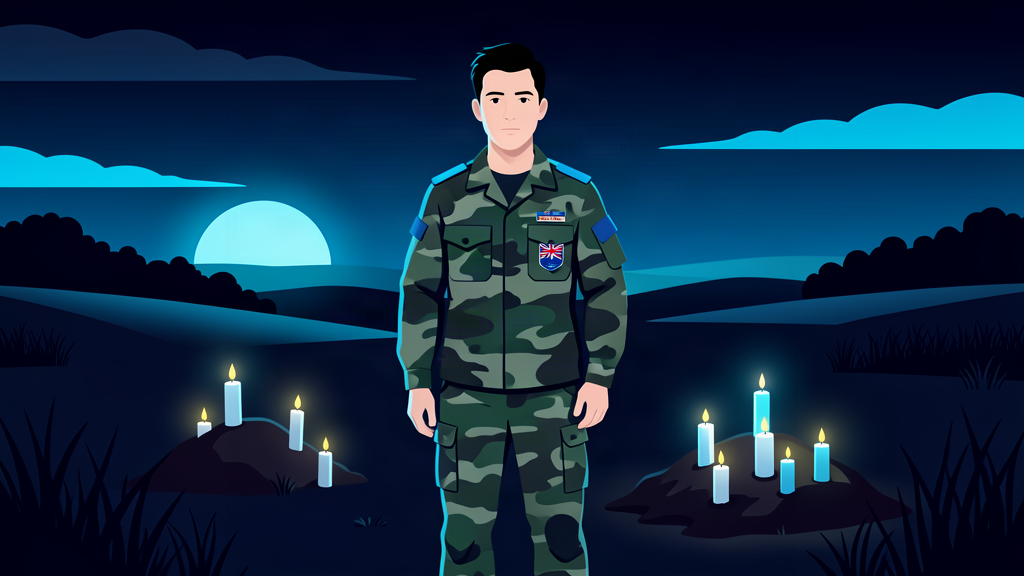
A former pupil of a Scottish school has been killed while fighting in Ukraine, prompting tributes from his former teachers and classmates who remember him as a young man deeply loved by his community. Arkadii Petrov, who attended Kirkcudbright Academy, was killed after returning to Ukraine to take part in the conflict, according to reports from the BBC.
The news has shocked the small community in Kirkcudbright, where Petrov was remembered as a quiet, committed individual who had left his schooling behind to return to the country of his birth. The school and his former classmates have paid tribute to a young man whose decision to go back and fight has ended in loss — a loss that his former community is now absorbing.
A former pupil’s journey
Details of Petrov’s path from Kirkcudbright Academy to the front line in Ukraine remain sparse, as is often the case with individual stories from the conflict. What is known is that he attended the school in Scotland and later returned to Ukraine — a country that has been at war since the full-scale invasion in 2022 — and that he died there.
The journey from a Scottish academy to the combat zones of eastern Europe is not a common one, but it reflects the broader pull that the war in Ukraine has exerted on members of the diaspora. For some, the decision to return has been driven by a sense of obligation, family ties, or a conviction that the country of their heritage needed them. For others, it has been a more personal choice, tied to individual circumstances that are not always visible from the outside.
The BBC’s report focuses on the reaction in Kirkcudbright rather than the specifics of the fighting that led to Petrov’s death — a choice that reflects the nature of the story as a local one, rooted in a community’s grief rather than in the wider tactical picture of the war.
Why it matters
The death of a former pupil in a foreign war is a reminder that the conflict in Ukraine is not only a matter of geopolitics, troop movements, and international alliances. It is also a matter of individual lives — people who have made choices, taken risks, and in some cases paid the ultimate price. Petrov’s story puts a face on that broader reality.

ADVERTISEMENT
For the communities in Scotland and elsewhere in the UK that have ties to Ukraine, the war has a personal dimension that is easy to lose in the aggregate statistics of casualties and territorial gains. Each death is a rupture in a specific set of relationships — a family, a school, a town. Petrov’s death is one such rupture, and the tributes from Kirkcudbright Academy reflect the impact it has had on the people who knew him before he left.
The story also speaks to the transnational nature of the conflict. Ukraine’s defence has drawn on a network of supporters, volunteers, and returnees from across the world. Not all of them are foreign fighters in the formal sense; some are expatriates, dual nationals, or members of the diaspora who have chosen to go back and stand on the side of the country they regard as home. Petrov’s story is one thread in that wider pattern.
What happens next
The immediate aftermath of a death like Petrov’s is a period of mourning and memorial. The school, his former classmates, and the community in Kirkcudbright will now find their own ways of marking the loss — whether through a gathering, a tribute, or a quiet acknowledgement that a former pupil will not be coming back.
Beyond that, the story closes as these individual stories often do: with grief, with remembrance, and with the broader conflict continuing around the person who has been lost. The BBC’s reporting captures the local dimension of that loss, and it does so at a moment when the war in Ukraine remains unresolved and the human toll continues to accumulate.

















We do not allow links of any sort in comments. No SPAM whatsoever. On topic comments only.