

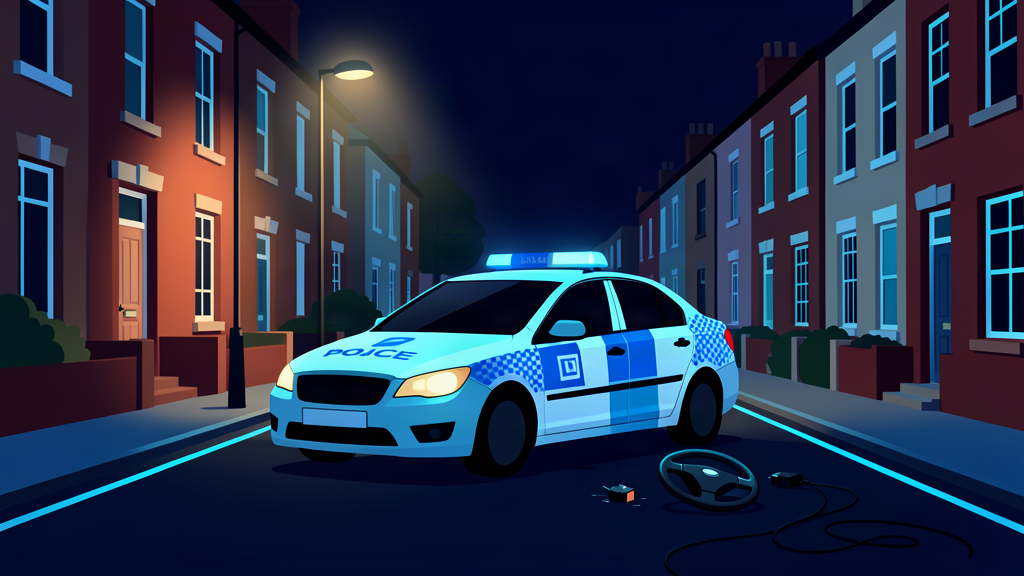
A car is stolen every four minutes across the United Kingdom, BBC investigators reveal, as organised criminal gangs exploit gaps in an overstretched police response that struggles to match increasingly sophisticated networks operating across England and Wales.
Police night-time operations
The BBC spent a night with Metropolitan Police officers during an eight-hour operation in the Havering area of east London, a district identified as particularly hard hit by thefts that feed into a global trade. Within 25 minutes of a stolen Ford Transit van being reported, patrols located it, pursued it and arrested a suspect. Yet the same shift uncovered broader criminal activity — armed robbers on e-bikes, a drunk driver and three men carrying Class A drugs, cash and phones — illustrating how vehicle crime investigations overlap with other serious offences.
From joyriding to global trade
Vehicle theft is no longer the work of opportunistic joyriders. Thieves operating in east London told the BBC that cars are stolen to order, moved across the country or dismantled within hours, with parts sold before a vehicle has even finished being broken down. Stolen vehicles surface in markets as distant as the United Arab Emirates, the Democratic Republic of Congo and Jamaica — a global supply chain that makes recovery and prosecution difficult and that law enforcement says crosses international borders with ease.
Across the UK, the economic toll is mounting. Security think tank Rusi estimates vehicle crime costs the UK economy £1.7 billion a year. Insurance premiums have risen 82% since 2021, according to the same analysis, though only 3% of vehicle theft offences last year resulted in a charge or summons. Fifteen of the 32 police forces in England and Wales that responded to a BBC Freedom of Information request said they do not employ any full-time, specially-trained stolen vehicle examiners — the specialists who can unlock forensic detail from a stripped car and link it to wider criminal enterprises.
Assistant Chief Constable Sarah Grahame, the national police lead on tackling vehicle crime, told the BBC that intensification weeks involving all 32 forces had recently led to 286 arrests and 319 vehicles seized. She admitted current theft levels are unacceptable but said there is no funding to routinely carry out large-scale operations within current police budgets set by the Home Office. Officers who spoke to the BBC privately said they had confidence in their ability to take down serious, organised vehicle crime networks, provided they had the necessary level of funding and support from decision-makers.
Technology outpaces security
Modern keyless entry systems have opened new avenues for theft. In East Sussex in September, 17 cars — many of them keyless Toyota RAV4s — were stolen in the Hastings and Rother areas in just two months. Three of the vehicles had been taken the previous night, yet within hours officers recovered all three and arrested three suspects. Thatcham Research, which works with carmakers and police, says thieves can develop targeted tools to steal a car within months of its launch, including devices hidden within wireless speakers that can start a vehicle by tapping into its internal communication system.

ADVERTISEMENT
Why it matters
Beyond the personal trauma to individual victims — several of whom reported burglars breaking into their homes demanding car keys — the surge in vehicle crime feeds directly into insurance costs that now affect millions of motorists. Victims like Mike Bull, whose BMW M3 was stolen after masked intruders broke into his home, and Rose-Marie Clarke, whose car was taken in 35 seconds using a signal-amplifying antenna, told the BBC they feel powerless as police struggle to keep up. The Home Office provides £300,000 a year to the National Vehicle Crime Reduction Partnership, but experts say this falls far short of what is needed.
What happens next
New legislation introduced in April making it an offence to possess electronic devices used in vehicle theft is being monitored by police and crime commissioners for its impact on keyless entry techniques. Parliament is expected to debate additional funding for specialised stolen-vehicle examiners during the autumn session. Meanwhile, car manufacturers including Toyota and the Society of Motor Manufacturers and Traders continue to insist they are working above and beyond regulatory requirements, while Thatcham Research calls for government regulations to mandate sophisticated anti-theft countermeasures as standard equipment on all new vehicles. For motorists, the four-minute clock keeps ticking regardless.
Source: BBC News





















We do not allow links of any sort in comments. No SPAM whatsoever. On topic comments only.