

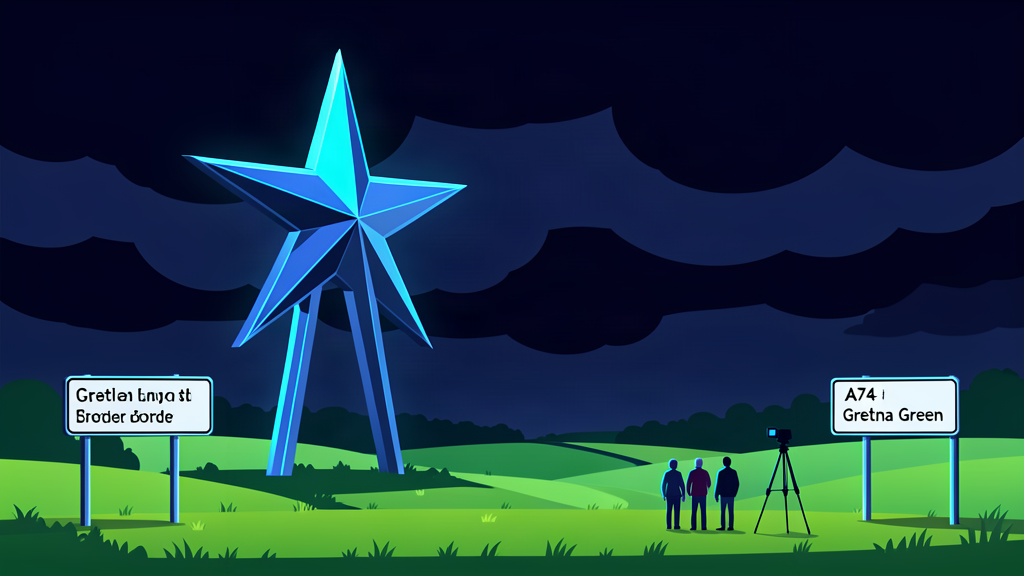
A landmark intended to mark the border between Scotland and England faces an uncertain future after a major backer withdrew its support. The Star of Caledonia at Gretna Green has become a familiar sight to motorists on one of Britain’s busiest north-south routes, but the BBC reports that the withdrawal of a key funder has left its future in doubt. The episode raises familiar questions about who pays for public art in Britain, and whether landmarks conceived to celebrate a place can survive when the money behind them disappears.
A star at the border
Gretna Green has long punched above its weight in the British imagination. The village, just inside Scotland, became famous for its runaway marriages and has kept that identity through centuries of change in the law. Its position close to the border, on the corridor between England and Scotland, makes it a natural place for a piece of work that says something about crossing from one country into another.
The Star of Caledonia was conceived as exactly that kind of marker: a visible sign that travellers had reached the edge of Scotland. Landmarks of this sort do a particular job. They turn an abstract line on a map into something people can photograph, remember and tell others about. For a country keen to present itself to visitors, that symbolic value can be as important as any practical signage, and the loss of a funder therefore matters well beyond the immediate construction budget.
Why it matters
Public art in the United Kingdom is usually caught between two worlds. It is often promoted by local campaigners and tourism bodies as a draw for visitors and a source of civic pride, yet it is frequently funded through a fragile mix of grants, donations and private philanthropy. When one major contributor steps away, a project that everyone assumed was secure can suddenly be left exposed. That is the position the Star of Caledonia now finds itself in, according to the BBC report.
The wider question is what a border landmark is for. Supporters argue that distinctive works give places an identity that cannot be replicated by a retail park or a service station, and that they help drive the kind of tourism spending that local businesses depend on. Sceptics point out that ambitious sculptures can cost substantial sums and may never repay the investment. Both arguments have force, and the Gretna Green project now sits squarely between them.
There is a Scottish dimension too. Since devolution, the country has paid closer attention to the symbols that express its identity, from flags and festivals to buildings and public spaces. A structure that greets people arriving from England carries that job almost literally on its shoulders. Letting it fade through simple neglect would be read by many as a statement in itself, which is why the funding gap is likely to attract opinion well beyond Dumfries and Galloway.

ADVERTISEMENT
What happens next
The immediate task is to establish whether the withdrawn support can be replaced. Landmark projects of this kind typically survive only if a new combination of public money, private donation or crowdfunding can be assembled, and campaigners will now be looking to make that case. Decisions about maintenance and long-term ownership will also need to be settled, since a sculpture that is welcomed at launch can become a liability if nobody is funded to look after it.
For now, the star remains standing, and travellers continue to pass it on their way north or south. Whether it becomes a lasting feature of the border or a short-lived experiment will depend on the next round of funding discussions. The BBC report makes clear that a major funder has withdrawn; it does not set out a replacement, so the project’s future remains open.




















We do not allow links of any sort in comments. No SPAM whatsoever. On topic comments only.