

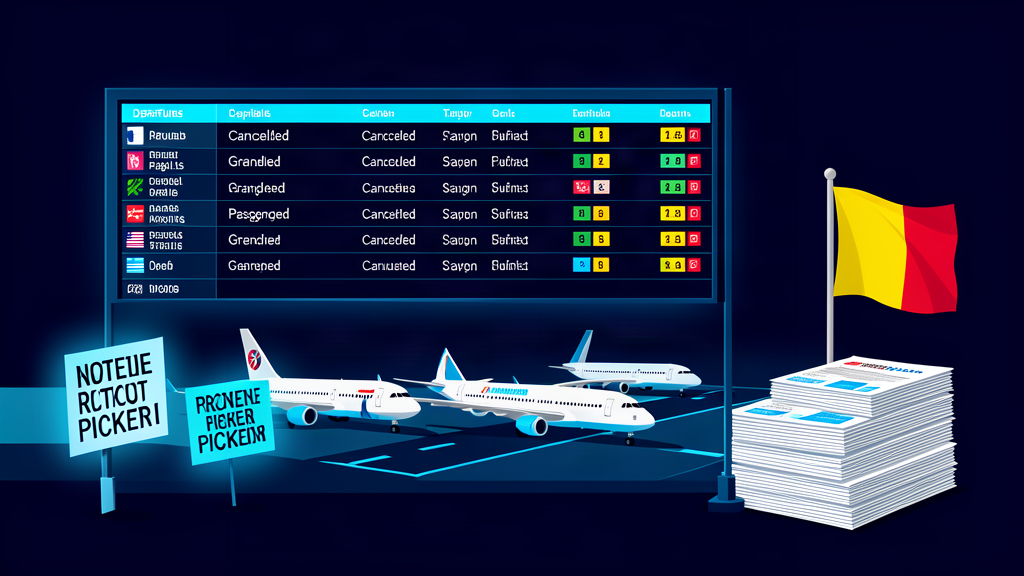
Flights have been cancelled in Belgium as a fresh wave of strikes over the cost of living sweeps the country, a sharp reminder of how affordability pressures are reshaping politics and public services across Europe. The disruption, reported by the BBC, is the latest in a series of stoppages that have hit Belgium in recent months, and it comes as the prime minister struggles to agree a budget that cuts public spending without further squeezing household finances. For Britain, the scenes carry a familiar resonance: industrial action rooted in the cost of living has shown repeatedly how quickly a dispute over pay and budgets can spill into the everyday travel of ordinary citizens.
Why the flights were cancelled
The immediate effect has been felt at airports, where flights were cancelled and passengers faced disruption after industrial action took hold. Strikes in the transport sector have an outsized impact because they intercept people at the point of departure, turning a dispute between unions and government into a problem for holidaymakers, business travellers and commuters alike. The BBC reports that the wider campaign reflects deep unease about the rising cost of everyday goods and services, with workers arguing that cuts to public spending risk making a difficult situation worse. What makes the Belgian stoppages notable is their persistence: rather than a single day of protest, the country has seen a run of actions over several months, each one adding to the pressure on ministers.
A budget that refuses to settle
At the centre of the dispute is the Belgian government’s attempt to agree a budget that reduces costs. The prime minister has been struggling to secure the backing needed for a package that would trim spending while keeping essential services intact. That is a familiar narrowing of options: governments under pressure to balance the books often find that every saving carries a political price, and that the groups asked to absorb the cuts are the same people already feeling the squeeze. The BBC’s reporting frames the strikes as part of a continuing confrontation rather than a one-off, suggesting the budget fight will run for some time yet.
A wider European picture
Belgium is not alone. Across Europe, governments are wrestling with the same tension between fiscal restraint and the living standards of voters, and strike action has become a regular feature of that argument. The choices made in Brussels matter well beyond Belgium’s borders: the city is home to the European Union and NATO, and disruption there is noticed by diplomats, businesses and travellers across the continent.
Why it matters
For the UK, the Belgian strikes are more than a foreign story. Britain has lived through its own wave of cost-of-living industrial action, and the questions facing ministers in Brussels — how to cut a budget without inflaming a cost-of-living crisis, how to keep transport running during a dispute, and how to maintain public services under strain — are the same questions facing Prime Minister Andy Burnham’s government at home. There is also a practical dimension: Belgium is a short crossing from British ports, and sustained disruption to its airports and rail links can affect UK travellers and supply chains. The pace of events in Brussels is a useful early indicator of how European governments are handling the affordability question that dominates domestic politics.
What happens next
The immediate priority for travellers is to check with airlines and operators before setting out, since further stoppages have not been ruled out. For the government, the coming days are likely to bring renewed attempts to bridge the gap between its budget plans and the demands of the unions. If a deal proves elusive, more strikes are possible, and the economic cost of disruption will strengthen the case for a compromise. Much will depend on whether ministers can find savings that do not land directly on the people already struggling with the cost of living — the same calculation that will determine whether the government can regain the initiative. Neither side has signalled that it is ready to climb down, so the standoff looks set to continue.

ADVERTISEMENT
Read the original report at BBC News – https://www.bbc.co.uk/news/articles/cwdr155e2d05o



















We do not allow links of any sort in comments. No SPAM whatsoever. On topic comments only.