

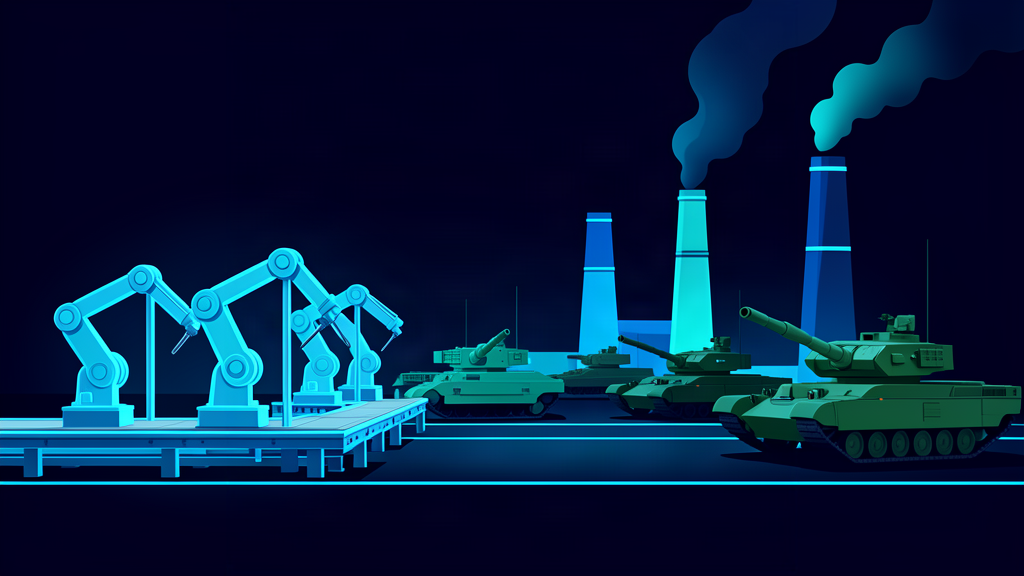
Europe’s car makers are in crisis, and a growing number of industry figures are asking whether the threat of renewed military demand could pull the sector out of its current slump. The idea is not new, but it has gained fresh currency as European governments rethink their defence posture and as car makers search for a way through falling demand, shrinking margins, and fierce competition from outside the continent.
An industry under pressure
European car manufacturing has been grappling with a difficult combination of forces for some time. Demand in key markets has been uneven, production costs have been rising, and the transition to electric vehicles has put enormous pressure on established supply chains and product plans. At the same time, Chinese manufacturers have expanded their presence in Europe with aggressively priced electric models, adding competitive pressure at precisely the moment when domestic producers most need a stable footing.
The crisis is not only about sales in the usual consumer sense. Car makers are also dealing with the strain of retooling factories, retraining workforces, and renegotiating relationships with suppliers who are themselves under pressure. That kind of industrial transition is expensive and risky, and it lands on top of the ordinary business challenges of managing a large manufacturing sector in an uncertain economic environment.
For a continent that has long treated its car industry as both an economic pillar and a symbol of industrial capability, the stakes are high. Cars are not just another consumer product in the European imagination; they are tied to questions of employment, regional identity, export strength, and technological leadership. A crisis in the car industry is therefore felt far beyond the showroom.
Why defence demand is back on the table
The renewed interest in military demand comes from a broader shift in European thinking about security. As defence spending rises across the continent and as governments look again at their industrial base, some of the same factories and engineering skills that once produced civilian vehicles are being examined with an eye to what else they could make. The logic is straightforward: a car factory has the capacity to shape metal, assemble complex systems, and run production lines at scale, which is also a description of what some defence manufacturing requires.
That overlap has drawn the attention of executives and policymakers who see an opportunity to connect two markets that have not always spoken to each other. If defence contracts could provide a steadier demand stream for some of the same industrial capacity, the argument goes, then the car sector might have a stronger foundation from which to manage the rest of its transition. It is an attractive idea in a continent where governments are now more willing to talk openly about industrial policy as a matter of security, not just economics.

ADVERTISEMENT
The concept is also appealing because it suggests a role for established European manufacturing that does not depend entirely on consumer demand or on outcompeting low-cost imports in the open market. In an industry that has spent years worrying about its global position, the prospect of a defence-linked demand base looks like a potential cushion against some of the market risks that have been causing so much damage.
Not a simple fix
For all its appeal, the idea of a defence-led rescue is not a straightforward answer. Car plants and defence factories are not identical, and the transition from consumer vehicles to military-related production would involve more than a change of orders on a production line. There are questions about capacity, about specialised tooling, about certification, and about whether the volume of defence demand would actually be enough to offset the scale of the wider car industry’s problems.
There is also the deeper question of what kind of industry Europe wants to have. If the car sector becomes more dependent on defence contracts, that changes its relationship to the market and to public policy. It may make some parts of the industry more resilient in one sense, but it also ties a consumer-facing industrial base more closely to government spending priorities and to the political decisions that surround defence planning. That is a trade-off, not a free upgrade.
The competitive angle matters too. Europe’s car makers are not just fighting for domestic demand; they are also competing globally. If the domestic market stabilises because of defence-related work, that does not automatically solve the challenge of holding share against overseas rivals in consumer markets. The two issues are related, but they are not the same problem.
What the industry is looking for
What car makers appear to be seeking is any credible path through the current downturn that does not simply mean waiting for consumer demand to improve while costs keep climbing. A rearmed Europe that needs vehicles, platforms, and components is one possible source of demand that sits within the industrial capabilities the sector already has. That is why the idea keeps coming up in conversations about the future of European manufacturing.
At the same time, industry leaders are careful not to present defence demand as a substitute for the fundamentals of a healthy car business. They still need competitive products, efficient factories, a reliable supply chain, and a market environment in which consumers can and want to buy. Military spending may help, but it is more useful as part of a broader industrial strategy than as a stand-alone rescue plan.
Why it matters
The fate of Europe’s car industry is a test of whether advanced manufacturing can remain viable in the continent under current conditions. If the sector is indeed in crisis, then the question of how it survives is not just an industrial one; it is about jobs, regions, exports, and the broader shape of the European economy. A defence-linked demand boost would matter because it could give the industry a floor while it deals with the longer-term challenges it faces.
It also matters because it blurs the boundary between civilian industry and defence preparation in a way that reflects a wider change in European thinking. When governments start asking whether car factories can help meet security needs, that is a sign that the old separation between peacetime production and defence industrial capacity is being reconsidered. The consequences of that shift will be felt across the whole sector.
What happens next
The next phase will be a period of industrial bargaining and policy debate. Car makers will continue to push for support, for clarity on regulation and demand, and for conditions that let them plan beyond the immediate crisis. Governments will continue to weigh how much they want to lean on defence spending as a tool of industrial policy, and how much they expect the market itself to sort out the rest.
The most interesting sign to watch is whether the idea moves from a hopeful talking point to concrete contracts and commitments. If military demand starts showing up in the order books in a meaningful way, then the argument that it could help rescue the sector will have moved from theory to evidence. Until then, it remains a promising but unproven alternative to the more conventional, and more difficult, work of fixing the consumer side of the business.






















We do not allow links of any sort in comments. No SPAM whatsoever. On topic comments only.